
Monday, April 24, 2006 AD
Helpful comment from a review of Phillip Johnson's book Darwin on Trial by Owen Gingerich. Gingerich, himself a Christian, suggests that Johnson has little understanding of how science works, and continues:
My previous post may have given the impression that I became, and remain, a Christian because the truth of Christianity - particularly the resurrection - had been "proven" to my satisfaction. It is far more a case of "building coherent patterns of explanation", interlocking patterns that build up and accumulate over time - calling to mind Chesterton's observation that:
I firmly believe that science concerns itself mostly with building coherent patterns of explanation, and rather little with proof. Lawyers seek proofs, and that's why I said that Phil Johnson was approaching science like a lawyer, somehow supposing that if he could show that evolution has no proofs, it would crumble. That, I think, is misguided.I think there's a lot to be said for the statement in bold as the appropriate aim for Christian apologetics, as well as for science.
My previous post may have given the impression that I became, and remain, a Christian because the truth of Christianity - particularly the resurrection - had been "proven" to my satisfaction. It is far more a case of "building coherent patterns of explanation", interlocking patterns that build up and accumulate over time - calling to mind Chesterton's observation that:
...a man is not really convinced of a philosophical theory when he finds that something proves it. He is only really convinced when he finds that everything proves it.Or perhaps we might say, when nothing proves it, but almost everything suggests it.


Sunday, April 23, 2006 AD
The fool says in his heart, "There is no God." (Psalm 14:1)The First Sunday after Easter (my Prayer Book-moulded mind still can't get used to calling it "the Second Sunday of Easter") is the "liturgical anniversary" of my return to the faith in 1994. And, now I think about it, Easter Day itself is the liturgical anniversary of my becoming an atheist in 1986. So, given the recent discussions on this site about Richard Dawkins, this seems an appropriate time to look at my own experience of having been an atheist - one no less committed and robust than Dawkins himself - between the ages of 13 and 21.
Before atheism
I was baptised in a Roman Catholic church, but my upbringing (particularly through my involvement in church music) was fairly mainstream/traditional Church of England. To this day my default settings for what constitutes "Christian worship" are the Alternative Service Book 1980's Holy Communion Rite A in the morning, and Evensong from the Book of Common Prayer in the evening. By the time I was 12 or 13 I was taking my faith fairly seriously, though I'm not sure how clear an understanding I had of the gospel.
Alongside this I also had a firm interest in science, going back at least to when I started school. In particular this included a strong interest in astronomy, and an only slightly less strong interest in dinosaurs and fossils. I knew that the universe came into existence about 15 to 20 billion years old, that the solar system formed 4.6 billion years ago, that the dinosaurs died out 65 million years ago, that humans evolved from around two million years ago, and that the sun would swallow the earth in about five billion years' time, as well as if these events had been part of my own direct life experience.
Becoming an atheist
This seems to have happened extremely suddenly. I was a member of the school Christian Union, though always a slightly semi-detached one (not least given my preference for traditional Anglican worship over modern ditties from "spiral-bound hymnbooks", as they were known in my family).
On the Easter weekend in 1986, shortly after my 13th birthday, a group of us from the CU went on an away-day to the school's "Outdoor Centre" at some particularly desolate spot in the Yorkshire Dales. I'm sure the content and style of the weekend were blameless enough in a Christian youth-camp sort of way, and I don't hold them responsible for my decision to throw my faith away.
One morning - as I recall, Easter Day itself - I was walking downstairs at the centre when I thought to myself, "Just because science can't currently explain how the Big Bang happened, doesn't mean that it will never be able to do so, or that we need to say that God did it."
And that was that. From that moment on I regarded myself as an atheist, and I imagine (though I don't recall for certain) that that was the end of any connection I had with the CU. I don't recall anyone from the CU trying particularly hard to persuade me back, either - but perhaps my memory really is being unfair, there.
Arguments for atheism
Having become an atheist, I then started to read up on the subject. The main books I read (and re-read, voraciously) on the subject were a couple of small books from the Rationalist Press Association that I found in the local library, and Julian Huxley's book Evolutionary Humanism, together with Isaac Asimov's essays on science, in particular his book Counting the Eons, my very well-read copy of which is currently sitting on the shelves three feet to my right, and which contains some particularly vigorous arguments against "scientific creationism".
It was the RPA booklets that provided the main arguments on which my atheism rested. In summary, the argument was as follows: Christians (and other religious believers) claim that God exists. They give certain proofs to support this contention, such as:
1. The argument from design.
2. The ontological argument.
3. The argument from "first causes" (i.e. there must be an ultimate "first cause").
4. The argument from morality.
And so on. None of these arguments hold water (as the book went on to demonstrate in each case), therefore Christians have failed to establish that God exists, therefore (with a swift application of Occam's Razor and, in retrospect, a certain amount of hand-waving) we conclude that atheism is the only rational position to adopt.
Those were not the only arguments I used in support of my atheism (a general contempt for "fundamentalist Christians" in general, and creationists in particular, helped as well). But this was still the main philosophical basis for my atheistic beliefs.
Returning to faith
This isn't the place to go into all the details of how God brought me back to faith in 1994. However, the absolutely key point is this: I did not become a Christian because I was persuaded that the traditional "proofs" for God's existence, as outlined above, were in fact correct. Rather, I encountered arguments that bypassed my objections to God's existence.
In particular, I was persuaded of the reliability and credibility of the apostles' account of the resurrection. The logic then went something like this (and I was very conscious at the time that this was the line of reasoning I was following): the most rational conclusion that can be drawn from the gospel accounts is that Jesus rose from the dead. Therefore, Jesus was the Son of God. Therefore, there must be a God for Jesus to be the Son of.
That was by no means the only thing that persuaded me to become a Christian, but that was certainly a key part of the process.
Reappraising the arguments for atheism
So where does that leave those arguments for atheism? Well, I am still profoundly unconvinced by the traditional arguments for God's existence as listed above. Even if they are technically correct - a big "if" in some cases - they do not necessarily lead people to the true and living God, the God and Father of our Lord Jesus Christ, rather than some shadowy Deist figure. And they also lack any power to transform unbelieving hearts, which can only be achieved by the Holy Spirit working through the proclamation of the gospel. I'm reminded of the story of Bertrand Russell, walking down The High in Oxford and suddenly exclaiming, "Well I never! The ontological proof is correct!" - without that leading him anywhere even in the vicinity of Christian faith.
When I came to look back at my eight years as an atheist, I realised that what I'd been doing was constructing a God of my own imagining and coming up with persuasive and convincing arguments not to believe in that imaginary God. I realised that I still don't believe in the God I didn't believe in as an atheist.
I'm not saying that's true of every atheist. I don't doubt there are many atheists who have a thorough and accurate knowledge of Christian theology, and who know full well what they are rejecting. But when I read comments like Richard Dawkins' defence of his theological ignorance ("It's a non-subject"), then I can't help but feel that people like Dawkins are doing exactly what I did in my teens: inventing an unbelievable God, and then duly disbelieving in him. On the plus side, that does at least leave the faintest glimmer of hope that Dawkins could one day find himself, as I was, taken by surprise by the true and living God.
Saturday, April 22, 2006 AD
In my previous post I mentioned Nick Matzke's extended dissection of Jonathan Wells's book Icons of Evolution, Icons of Obfuscation. I don't know what Matzke's religious affiliation is, but he is clearly some way removed from the "evolution = atheism" position of someone like Richard Dawkins - or, for that matter, Ken Ham. (Dawkins and Ham are like antiparticles of one another, working on basically the same logic but drawing opposite conclusions. And, like antiparticles, it would be best not to be around should they ever meet...)
As Matzke comments (in the section on Wells's chapter on fossil horses) that what really seems to motivate Wells is the belief that evolutionary biology's emphasis on the "random" and "undirected" nature of evolution undermine the Christian doctrine of divine creation. Matzke continues:
As Matzke comments (in the section on Wells's chapter on fossil horses) that what really seems to motivate Wells is the belief that evolutionary biology's emphasis on the "random" and "undirected" nature of evolution undermine the Christian doctrine of divine creation. Matzke continues:
Two points should be made about the words like "random" and "undirected," which Wells digs out of several textbooks (as if the purpose of a science textbook is to be a philosophical treatise suitable for word-by-word analysis for conceivably debatable points).In response to this, Matzke comes out with an interesting analogy with another area of science:
Readers should ask themselves: is the weather "random" and "undirected", or not?In the conclusion to his article, Matzke revisits this analogy:
- If yes, according to Wells you are subscribing to "materialistic philosophy in the guise of empirical science" and we should expect Wells to write his next book about the dogmatic materialism of meteorologists (and statisticians, etc.).
- If you think that Wells may be overreacting a wee bit to the implications of such words (perhaps because of the provocation provided by certain campaigners for atheism such as Dawkins, who is an excellent zoologist but who should do a better job of keeping his metaphysics separate from his science), then join the club, and consider the possibility that evolution is "random" and "undirected" in the very same way that the weather is considered "random" and "undirected."
But is it really necessary to force theology into science? As we saw in the fossil horses chapter, Wells imputes far more metaphysical significance to words such as "random" and "undirected" than they actually have scientifically. Scientifically, evolution is described as "random" and "undirected" in the same way that the weather, earthquakes, and numerous other natural processes are described as "random" and "undirected." (For that matter, evolution is also predictable in a way similar to weather and earthquakes.) Does describing the weather, or evolution, as somewhat "random" really have the offensive metaphysical implications that Wells thinks?As an alternative to Wells's position, Matzke offers a quotation from the biologist Theodosius Dobzhansky, whose statement "Nothing in biology makes sense except in the light of evolution" Wells decries, without mentioning that Dobzhansky was in fact "a lifelong Russian Orthodox Christian". Indeed, the very same article by Dobzhansky from which that quote is taken includes the following statement:
"It is wrong to hold creation and evolution as mutual exclusive alternatives. I am a creationist and an evolutionist. Evolution is God's, or Nature's, method of creation. Creation is not an event that happened in 4004 B.C.; it is a process that began some 10 billion years ago and is still under way.I'd be particularly interested to hear what others think of Matzke's comparison of "random and undirected" evolution with "random and undirected" weather. It is certainly the case that the biblical teaching (and Christian conviction) that God is in ultimate control of the weather has not been particularly shaken by the fact that meteorologists have found there to be considerable explanatory and predictive value in treating the weather as random and undirected.
"Does the evolutionary doctrine clash with religious faith? It does not. It is a blunder to mistake the Holy Scriptures for elementary textbooks of astronomy, geology, biology, and anthropology. Only if symbols are construed to mean what they are not intended to mean can there arise imaginary, insoluble conflicts. As pointed out above, the blunder leads to blasphemy; the Creator is accused of systematic deceitfulness."
Some recent reading on the whole creation/evolution/intelligent design thing that's been (re-)occupying my thoughts recently (as it tends to every year or two). It would take too long to blog on these in detail so these are really just links for y'all to follow if you're interested:
- I enjoyed reading Michael Behe's book Darwin's Black Box a couple of years ago, but Pete Dunkelberg's response, Irreducible Complexity Demystified, seems to do an effective job of refuting Behe's suggestions concerning "irreducible complexity".
Behe's book is still well worth reading, though, for its fascinating descriptions of complex biological systems such as bacterial flagella and the blood-clotting cascade (though apparently even Behe now concedes the latter is not "irreducibly complex"). - A book I enjoyed rather less than Behe's when I read it was Jonathan Well's Icons of Evolution. Even when I was at my most sympathetic to a creationist account, it seemed a pretty lame argument to say, "Many of the examples of evolution used in school textbooks are incorrect, therefore evolution is just the product of a Vast Conspiracy Of Evil Biologists".
However, Nick Matzke's article Icon of Obfuscation argues convincingly that Wells has misrepresented the status of these "icons of evolution" - many of them (such as peppered moths) have not been discredited as examples of natural selection, and even where some "icons" have been discredited (such as Haeckel's embryo drawings) that has not led experts in the relevant fields to a change of view as to the underlying science.
The article is also interesting because Nick Matzke, while I've no idea whether or not he is a Christian, clearly has no time for suggestions by the likes of Richard Dawkins (whom he describes as "an excellent zoologist but who should do a better job of keeping his metaphysics separate from his science") that evolution necessitates a materialistic view of the universe with no room for the existence of God. I hope* to say more on this aspect of Matzke's article later. (*Happy now, Thomas? ;-) ) - Interesting post from David Heddle, himself an advocate of intelligent design (ID), but who argues that (i) ID isn't science; (ii) ID shouldn't be taught in schools; and (iii) ID proponents should cease attempting to deny that ID is religiously motivated.
Given that I thought the whole idea of ID was to say, "Setting aside religious convictions and the precise identity and nature of any 'Designer', the scientific evidence still points to design", I'm not entirely sure where this leaves ID as a concept. In particular, it is difficult to see how we can distinguish Heddle's version of ID ("weak ID"?) from many forms of theistic evolution - both views insisting on a separation between what can be scientifically observed, and what we understand from God's revelation of himself. - And finally, a great post from Michael Spencer from last month, Answers Not In Genesis. Michael describes himself as "ashamed and discouraged" to read about a creationist rally at which Ken Ham teaches children to take on their science teachers with cries of "Were you there?". Michael observes that:
Saying that the Bible is about Jesus, God’s Final Word of salvation, and not about geology and astrophysics is still a minority view.
He also recommends a book by Conrad Hyers, The Meaning of Creation: Genesis and Modern Science, which I've duly added to my list of blogging-influenced book purchases. Sounds like a good companion to one of my favourite books on Genesis, Henri Blocher's In The Beginning. - And the mention of Blocher's book (which argues for the "literary framework" approach to Genesis 1) is as good as time as any to link to two seminal articles arguing for that approach: Meredith Kline's Because it had not rained, and his later follow-up article, Space and Time in the Genesis Cosmogony. Lee Irons then summarises the framework hypothesis here.
Thursday, April 20, 2006 AD
 One of Richard Dawkins' main objections to religion (see previous posts: 1 | 2 | 3 | 4 | 5) is that it is "aesthetically deficient" (Alister McGrath, Dawkins' God, p.146). As Dawkins writes (cited on p.146):
The universe is genuinely mysterious, grand, beautiful, awe-inspiring. The kinds of views of the universe which religious people have traditionally embraced have been puny, pathetic, and measly in comparison to the way the universe actually is. The universe presented by organised religions is a poky little medieval universe, and extremely limited.McGrath gives this both barrels:
The logic of this bold assertion is rather hard to follow, and its factual basis astonishingly slight.Yes, the "medieval" view of the universe may have been "more limited and restricted than modern conceptions". But this was scarcely the fault of religion:
It reflected the science of the day, largely based upon Aristotle's treatise de caelo ("on heaven"). If the universe of religious people in the Middle Ages was indeed "poky", it was because they trusted the best cosmologists of the day to tell them what it was like. This, they were assured, was scientific truth, and they accepted it. They took it on trust. They were naive enough to assume that what their science textbooks told them was right.But in any event, medieval conceptions of the universe weren't all that "poky" to start with. The prevailing view in the Middle Ages was the Ptolemaic system, "which located the earth at the centre of a vast, ordered cosmic mechanism":
On this grand view of the universe, the earth stood at the centre of a series of concentric spheres, each of which rotates about the earth according to its own predetermined rhythm. Beyond them lies the "empyrean" - a vast, eternal, infinite, and formless void.The picture illustrating this post is a depiction of this Ptolemaic universe, taken from the Nuremberg Chronicle of 1493.
As McGrath continues:
It's not today's model of the solar system, and is wrong at just about every point ... but it's hardly a "poky little universe". Most medieval writers that I have read on the topic found the thought of cosmic vastness to be really rather awesome.(That said, by our standards the medieval concept of "cosmic vastness" does seem a little, well, poky - as does, to be honest, the young-earth creationist notion that the universe is <10,000 years old. But that doesn't take away McGrath's core points, namely (i) the medieval universe wasn't quite as "poky" as Dawkins makes out, and (ii) in any event, almost no Christians today subscribe to that view of the universe anyway.)
If anything, it is the atheistic conception of the universe that is deficient. McGrath points out there are three main aspects to the "awe" that we can all experience in relation to the universe:
- "An immediate sense of wonder at the beauty of nature."
- "A derived sense of wonder at the mathematical or theoretical representation of reality."
- "A further derived sense of wonder at what the natural world points to ... that the creation bears witness to its creator"
The creatures of the world lead the souls of the wise and contemplative to the eternal God ... every creature is by its very nature [a] kind of depiction and likeness of that eternal wisdom.
In the final chapter of Dawkins' God (see previous posts: (1 | 2 | 3 | 4), Alister McGrath looks at Dawkins' response to suggestions of an increasing "convergence" between science and religion. McGrath describes as "admirably robust" Dawkins' response to such a notion:
But then, the prevailing notion that the natural relationship between science and religion is one of unceasing conflict has been equally damaging for the gospel, given the privileged status that scientific accounts of reality enjoy in our society. And McGrath goes on to argue very effectively that this received view of a "protracted war between church and science" is now seen as inaccurate and misleading:
We will turn to one of those "wildly rheotorical salvoes" in the final post in this series.
"To an honest judge," he writes - perhaps with himself modestly in mind? - "the alleged convergence between religion and science is a shallow, empty, hollow, spin-doctored sham".Actually, this is one area in which I find myself in a measure of agreement with Prof. Dawkins: I fear that any such convergence, "alleged" or otherwise, is likely to be as deadly for scriptural, orthodox Christianity as it was the last time such a convergence occurred, in the eighteenth century. The problem with Deism is that it is so easily mistaken for genuine Christianity - not a mistake anybody is likely to make with Richard Dawkins' views.
But then, the prevailing notion that the natural relationship between science and religion is one of unceasing conflict has been equally damaging for the gospel, given the privileged status that scientific accounts of reality enjoy in our society. And McGrath goes on to argue very effectively that this received view of a "protracted war between church and science" is now seen as inaccurate and misleading:
In recent years, the scholarly understanding of the historical relationship of science and religion has undergone an intellectual revolution no less than that occasioned by Darwin's Origin of SpeciesIndividual, local conflicts - such as that between Galileo and the Roman church - reflected "institutional politics and personal agendas", or simply "misunderstandings", rather than being "typical or defining". Dawkins' views on this issue are, McGrath suggests, "firmly rooted in the social world of nineteenth-century England". McGrath continues with a swift kick to Dawkins' shins:
It is understandable that [such views] should linger in some works of popular science - after all, academic historical scholarship takes a long time to filter down.He goes on to argue that:
[T]he notion of an endemic conflict between science and religion ... is itself socially determined, created in the lengthening shadows of hostility towards individual clergy and church institutions.One of the most significant developments in Victorian society was the emergence of a class of professional scientists, in growing competition with the amateur "scientific parsons" of the eighteenth and early nineteenth centuries:
With the appearance of the professional scientist ... a struggle for supremacy began, to determine who would gain the cultural ascendancy within British culture in the second half of the nineteenth century...This "stereotype" of a war between science and religion lingers on today, and McGrath expresses regret that Dawkins has declined the opportunity to take a constructive role in the "positive and constructive dialogue and engagement" now taking place on this issue, preferring instead to "[fire] off inaccurate, wildly rheotorical salvoes, and lampooning those who disagree with him."
The "conflict" model of science and religion thus came to prominence at a time when professional scientists wished to distance themselves from their amateur colleagues, and when changing patterns in academic culture necessitated demonstrating its independence from the church and other bastions of the establishment. Academic freedom demanded a break with the church; it was a small step towards depicting the church as the opponent of learning and scientific advance...
We will turn to one of those "wildly rheotorical salvoes" in the final post in this series.
Wednesday, April 19, 2006 AD
In one of the comments on the back of Alister McGrath's book Dawkins' God (1 | 2) | 3), Michael Ruse comments that he "cannot wait to see Dawkins' response of Alister McGrath's critique".
Well, Richard Dawkins seems to have declined the opportunity to respond at length to Alister McGrath. However, he did respond briefly to an interview with Alister McGrath on the Science & Theology News site. So here is Richard Dawkins' response to McGrath's suggestion (covered in my previous post) that he is ignorant of Christian theology:
However, in the closing chapters of his book McGrath moves beyond simply demolishing Dawkins' views and makes some interesting positive points about the history of science, and we will take a look at this in the last couple of posts in this series.
Well, Richard Dawkins seems to have declined the opportunity to respond at length to Alister McGrath. However, he did respond briefly to an interview with Alister McGrath on the Science & Theology News site. So here is Richard Dawkins' response to McGrath's suggestion (covered in my previous post) that he is ignorant of Christian theology:
"Yes, I have, of course, met this point before. It sounds superficially fair. But it presupposes that that there is something in Christian theology to be ignorant about. The entire thrust of my position is that Christian theology is a non-subject. It is empty. Vacuous. Devoid of coherence or content. I imagine that McGrath would join me in expressing disbelief in fairies, astrology and Thor’s hammer. How would he respond if a fairyologist, astrologer or Viking accused him of ignorance of their respective subjects?This depressing affirmation of wilful ignorance tends to underscore Thomas' point that perhaps Prof Dawkins isn't perhaps worth all this trouble. But, as I said in reply to Thomas, for all that Prof Dawkins has nothing that is worth saying about religion, he is nevertheless treated by the media (at least in the UK) as a sort of atheistical counterpart to the Archbishop of Canterbury. So it was well worth Alister McGrath's while in taking Dawkins on and revealing the intellectual (let alone spiritual) barrenness of his position.
The only part of theology that could possibly demand my attention is the part that purports to demonstrate that God does exist. This part of theology I have, indeed, studied with considerable attention. And found it utterly wanting.
However, in the closing chapters of his book McGrath moves beyond simply demolishing Dawkins' views and makes some interesting positive points about the history of science, and we will take a look at this in the last couple of posts in this series.
In the third chapter of Dawkins' God (see previous posts: 1 | 2), Alister McGrath turns to Dawkins more explicitly "theological" pronouncements, and particularly Dawkins' views on the nature of religious faith. McGrath is not impressed with what he finds:
McGrath dismisses Dawkins' definition of faith as "ludicrous", and points out that Dawkins offers no evidence "that anyone - let alone religious people - defines 'faith' in this absurd way":
The problem lies in Dawkins' failure to take into account "the way in which words are used in religious contexts" (p.97) - a point that should be obvious to a professional scientist, working in a context in which everyday words (such as "sugar") have very different meanings from their everyday usage. Indeed, Dawkins is well aware of this point when it suits his purpose, such as when he "famously lambasted philosopher Mary Midgley for criticizing his 'selfish gene' hypothesis without any awareness of how scientists used language." As Dawkins wrote then:
To put it bluntly, Dawkins' engagement with theology is superficial and inaccurate, often amounting to little more than cheap point scoring. (p.83)In particular, Dawkins' "tendency to misrepresent the views of his opponents is the least attractive aspect of his writings". One recurring example of this tendency in Dawkins' works is his understanding of the word "faith", which Dawkins defines as "blind trust, in the absence of evidence, even in the teeth of evidence" (cited on p.84). In a 1992 lecture, Dawkins expanded on this assertion as follows:
Faith is the great cop-out, the great excuse to evade the need to think and evaluate evidence. Faith is belief in spite of, even perhaps because of, the lack of evidence ... Faith is not allowed to justify itself by argument. (cited on p.84)Dawkins has even described faith (defined in this manner) as "a kind of mental illness", even as a "virus", one "comparable to the smallpox virus but harder to eradicate" (p.84).
McGrath dismisses Dawkins' definition of faith as "ludicrous", and points out that Dawkins offers no evidence "that anyone - let alone religious people - defines 'faith' in this absurd way":
No evidence is offered that [this definition] is representative of religious opinion. No authority is cited in its support. I don't accept this definition of faith, and I have yet to meet a theologian who takes it seriously. It cannot be defended from any official declaration of faith from any Christian denomination. (p.85)Faith as blind trust "may be what Dawkins thinks; it is not what Christians think". McGrath offers as an alternative the "good and reliable" definition of faith given by the Anglican theologian W.H. Griffith-Thomas:
[Faith] affects the whole of man's nature. It commences with the conviction of the mind based on adequate evidence; it continues in the confidence of the heart or emotions based on conviction, and it is crowned in the consent of the will, by means of which the conviction and confidence are expressed in conduct. (p.86)Not surprisingly, Dawkins has little difficulty in knocking down the "straw man" he has set up. After all, to do so "is not an unduly difficult or demanding intellectual feat" (p.86).
The problem lies in Dawkins' failure to take into account "the way in which words are used in religious contexts" (p.97) - a point that should be obvious to a professional scientist, working in a context in which everyday words (such as "sugar") have very different meanings from their everyday usage. Indeed, Dawkins is well aware of this point when it suits his purpose, such as when he "famously lambasted philosopher Mary Midgley for criticizing his 'selfish gene' hypothesis without any awareness of how scientists used language." As Dawkins wrote then:
[Midgley] seems not to understand biology or the way biologists use language. No doubt my ignorance would be just as obvious if I rushed headlong into her field of expertise, but I would then adopt a more diffident tone. As it is we are both in my corner, and it is hard for me not regard the gloves as off.Feel free to spend a few moments gaping, slack-jawed, at the man's complete lack of self-awareness, and then let's rejoin Alister McGrath as he draws the obvious conclusion:
There is a total failure on Dawkins' part to even begin to understand what Christian theology means by its language. It really does make it very difficult to take his judgments concerning its alleged failures with any degree of seriousness.
Tuesday, April 18, 2006 AD
I've just made a couple of purchases off Amazon based on recommendations in comments left on this site.
 First, Richard Dawkins' The Ancestors' Tale, as recommended by my friend Nick, in which (in the manner of the Guinness ad I linked the other week) Dawkins takes the reader on a "pilgrimage" back in time through the (alleged/purported/whatever, dude) history of evolution from now back to the dawn of life on earth. Nick describes it as "magisterial in its tracing back of our common ancestors with other life forms".
 And then to accompany that (and help me get towards the magic £15 free postage mark), Christian palaeontologist Simon Conway Morris' book The Crucible of Creation: The Burgess Shale and the Rise of Animals, looking at the fossil evidence for the "Cambrian Explosion", and recommended by the endlessly rocking Thomas. Thomas describes Morris as a "paleontologist extraordinaire and lover of God's creation (in every sense)". Great cover, too (click the thumbnail for a larger view).
These both look pretty splendid, and should keep me going for quite a while.
First, Richard Dawkins' The Ancestors' Tale, as recommended by my friend Nick, in which (in the manner of the Guinness ad I linked the other week) Dawkins takes the reader on a "pilgrimage" back in time through the (alleged/purported/whatever, dude) history of evolution from now back to the dawn of life on earth. Nick describes it as "magisterial in its tracing back of our common ancestors with other life forms".And then to accompany that (and help me get towards the magic £15 free postage mark), Christian palaeontologist Simon Conway Morris' book The Crucible of Creation: The Burgess Shale and the Rise of Animals, looking at the fossil evidence for the "Cambrian Explosion", and recommended by the endlessly rocking Thomas. Thomas describes Morris as a "paleontologist extraordinaire and lover of God's creation (in every sense)". Great cover, too (click the thumbnail for a larger view).These both look pretty splendid, and should keep me going for quite a while.
Richard Dawkins' best-known work, after The Selfish Gene, is possibly The Blind Watchmaker, which Alister McGrath (see previous post) describes as:
Paley's book "had a profound influence on popular English religious thought in the first half of the nineteenth century", writes McGrath (p.63), and it is known that Charles Darwin had read Paley's work. Ironically, Dawkins (whom McGrath describes as "eloquent and generous" in his treatment of Paley) probably has a more positive view of Paley than McGrath, who states that:
McGrath's disagreement is not with Dawkins' demolition of Paley's arguments, but with Dawkins' belief that Paley's theory represented the universal view of Christians throughout the ages, so that to demolish Paley is to demolish the Christian doctrine of creation. As McGrath argues:
In short, continues McGrath:
...a significant and highly successful attack on the eighteenth-century concept of God as "watchmaker". (p.60)The title of Dawkins' book is aimed at William Paley, whose Natural Theology of 1802 set out his famous analogy comparing the complexity of nature with that of a watch, and arguing that therefore nature requires a creator just a surely as a watch requires a watchmaker.
Paley's book "had a profound influence on popular English religious thought in the first half of the nineteenth century", writes McGrath (p.63), and it is known that Charles Darwin had read Paley's work. Ironically, Dawkins (whom McGrath describes as "eloquent and generous" in his treatment of Paley) probably has a more positive view of Paley than McGrath, who states that:
The analogy, like most of Paley's work, was borrowed, and the scholarship decidedly second rate.Dawkins argues that natural selection can account for biological complexity without the need to invoke a "watchmaker", and that the impression of design is in fact an illusion: the "only watchmaker in nature is the blind forces of physics" (cited on p.66).
McGrath's disagreement is not with Dawkins' demolition of Paley's arguments, but with Dawkins' belief that Paley's theory represented the universal view of Christians throughout the ages, so that to demolish Paley is to demolish the Christian doctrine of creation. As McGrath argues:
What Dawkins actually demonstrates is that a very specific understanding of the doctrine of creation, which came into being in response to the historical circumstances of eighteenth century England, is completely undermined by a Darwinian account of evolution.However, Paley's views had already come under considerable criticism on theological grounds, some time before Darwin published The Origin of Species. In 1852, John Henry Newman attacked Paley's arguments in a series of lectures at Dublin University, describing "physical theology" (i.e. "natural theology") as "a false gospel":
Physical Theology cannot, from the nature of the case, tell us one word about Christianity proper; it cannot be Christian, in any true sense, at all ... Nay, more than this; I do not hesitate to say that, taking men as they are, this so-called science tends, if it occupies the mind, to dispose it against Christianity. (cited on p.68)Newman's words could be applied with equal force today to counter some of the wilder claims made for the Intelligent Design movement - which, whatever the scientific validity of its claims, is just as likely to lead into a revival of Deism or belief in a Shavian "life force", as it is to encourage belief in a Christian account of creation.
In short, continues McGrath:
Paley must be seen in his historical context ... Darwin's Origin of Species must be seen as a nineteenth-century refutation of an eighteenth-century idea - an idea already rejected by leading Christian writers of the age. But it cannot be regarded as a refutation of Christianity itself - merely of a wrong turn that the English national church took.As for Dawkins, his mistake is to assume that Paley's approach is "typical or normative for Christianity", and that "the intellectual case for Christianity rests largely, if not totally, upon an 'argument for design'" (p.71). As neither of these is in fact the case, McGrath concludes that:
Dawkins makes a superb case for abandoning Paley. Sadly, he seems to think this also entails abandoning God.
Monday, April 17, 2006 AD
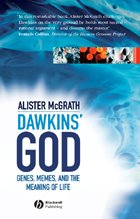 I've just finished Alister McGrath's book about Richard Dawkins, Dawkins' God, in which McGrath examines Dawkins' views on religion and Darwinism (I mentioned this book in passing the other day).
McGrath is ideally suited to take Dawkins on: before becoming a theologian, he had earned a doctorate in biochemistry at Oxford University. Indeed, McGrath was first approached to write a book responding to Dawkins' The Selfish Gene in the late 1970s, but declined to do so at the time as he was confident someone better-qualified would do so before long. By 2003, in the absence of any such book being written during the intervening quarter-century, he finally decided to do so himself.
McGrath opens his book by describing his admiration for Dawkins' work, particularly The Selfish Gene:
I admired Dawkins' wonderful way with words, and his ability to explain crucial - yet often difficult - scientific ideas so clearly. It was popular scientific writing at its best. (p.1)Anyone who has read any of Dawkins' popular science books will cheerfully concur with this judgment. The only book by Dawkins I've read in full is Climbing Mount Improbable, and the closing chapter on the symbiotic relationship between figs and fig-wasps is a tour de force. As McGrath says of The Selfish Gene:
By any standards, The Selfish Gene was a great read - stimulating, controversial and informative. Dawkins had that rare ability to make complex things understandable, without talking down to his audience ... It was heady stuff. (p.7)But from the start, "traces of a markedly anti-religious polemic could be discerned" (p.1). Worse, Dawkins' arguments against were of a markedly lower quality than his arguments for Darwinism, being based on "plodding rhetoric and tired old cliches" (p.10) rather than the evidence-based approach of his scientific writing. Far from producing "a new, intellectually reinvigorated atheism", McGrath notes with disappointment that:
Dawkins' atheism seemed to be tacked onto his evolutionary biology with intellectual velcro. (p.10)Hence this book. McGrath makes it clear that "this book is not a critique of Dawkins' evolutionary biology", but on "the broader conclusions that he draws from these, particularly concerning religion and intellectual history" (p.11). I will look at some of McGrath's points in more detail in subsequent posts, starting with his examination of Dawkins' demolition of (a particular version of) the "argument from design" in The Blind Watchmaker.
 Following on from NT Wright's dissection of the "Gospel of Judas", the Archbishop of Canterbury devoted his Easter sermon (and an article in the Mail on Sunday) to a call for people to believe the biblical accounts of Jesus' resurrection instead of "conspiracy theories" such as those found in the "Gospel of Judas" or The Da Vinci Code.
As regards the "Gospel of Judas" and claims made that this text would "shake the foundations of traditional belief by giving an alternative version of the story of the passion and resurrection", Dr Williams observes:
Never mind that this is a demonstrably late text which simply parallels a large number of quite well-known works from the more eccentric fringes of the early century Church; this is a scoop, the real, ‘now it can be told’ version of the origins of Christian faith.Such stories are now as traditional a part of the Easter period as chocolate eggs, and Dr Williams identified them as coming from a very contemporary mindset:
We are instantly fascinated by the suggestion of conspiracies and cover-ups; this has become so much the stuff of our imagination these days that it is only natural, it seems, to expect it when we turn to ancient texts, especially biblical texts. We treat them as if they were unconvincing press releases from some official source, whose intention is to conceal the real story; and that real story waits for the intrepid investigator to uncover it and share it with the waiting world.As a result:
...the modern response to the proclamation, ‘Christ is risen!’ is likely to be, ‘Ah, but you would say that, wouldn’t you? Now, what’s the real agenda?’This suspicion of church doctrine is perhaps to be expected, given that "the Church has historically been part of one or another sort of establishment and has often stood very close to political power", but this approach doesn't help us understand "what the New Testament writers are actually saying and why":
For the Church does not exist just to transmit a message across the centuries through a duly constituted hierarchy that arbitrarily lays down what people must believe; it exists so that people in this and every century may encounter Jesus of Nazareth as a living contemporary.And the means by which we encounter Jesus today are the Word and Sacraments:
This sacrament of Holy Communion that we gather to perform here is not the memorial of a dead leader, conducted by one of his duly authorised successors who controls access to his legacy; it is an event where we are invited to meet the living Jesus as surely as did his disciples on the first Easter Day.(Note: I don't agree with Dr Williams' implication here that the Bible is merely the conduit for us to hear the Word of God, rather than being the Word of God in itself. But we'll let that pass for now.)
And the Bible is not the authorised code of a society managed by priests and preachers for their private purposes, but the set of human words through which the call of God is still uniquely immediate to human beings today, human words with divine energy behind them.
One key point Dr Williams makes relates to the nature of the New Testament, which is far removed from the conspiracy theorists' image of an all-powerful church creating and assembling the texts that would entrench its dominance over people's lives. On the contrary:
...it was written by people who, by writing what they did and believing what they did, were making themselves, in the world’s terms, less powerful, not more. They were walking out into an unmapped territory, away from the safe places of political and religious influence, away from traditional Jewish religion and from Roman society and law ... [T]hey were putting themselves in a place where they shared the humiliation experienced by condemned criminals going naked in public procession to their execution.Dr Williams quotes a member of the Melanesian Brotherhood, who wrote (as part of a reflection on the martyrdom of seven members of his order) that "we know where we stand and we know who we belong to":
‘We know where we stand and we know who we belong to’. Beyond all the history of confusion and betrayal that surrounds a lot of the Church’s history, beyond the power games that we still play in the churches, this one rocklike conviction remains, the conviction that drove the writing of every word of the New Testament. Nothing to do with conspiracies, with the agenda of the powerful; everything to do with how the powerless, praying , risking their lives for the sake of Christ and his peace, are the ones who understand the Word of God.(Note: HT to the iMonk/Van Til for inspiring the picture adorning this post.)
And to accept that is not to sign up to the agenda of a troubled, fussy human society of worried prelates and squabbling factions. It is to choose life, to choose to belong to the life-giver.
Sunday, April 16, 2006 AD
Between the Easter breakfast (which I'm still digesting...) and the start of the 11 am service, I found myself flicking through a copy of Don Carson's For the Love of God, his two-volume series of devotionals based on the M'Cheyne Bible reading plan.
Looking for something Easter-related, I turned to his entry for Luke 24, which turned out to consist of the following poem/hymn, to be sung to the Londonderry Air (I've anglicised the spellings):
Looking for something Easter-related, I turned to his entry for Luke 24, which turned out to consist of the following poem/hymn, to be sung to the Londonderry Air (I've anglicised the spellings):
They came alone: some women who remembered him,
Bowed down with spices to anoint his corpse.
Through darkened streets, they wept their way to honour him--
The one whose death had shattered all their hopes.
"Why do you look for life among the sepulchres?
He is not here. He's risen, as he said.
Remember how he told you while in Galilee:
The Son of Man will die--and rise up from the dead."
The two walked home, a study in defeat and loss,
Explaining to a stranger why the gloom--
How Jesus seemed to be the King before his cross,
How all their hopes lay buried in his tomb.
"How slow you are to see Christ's glorious pilgrimage
Ran through the cross"--and then he broke the bread.
Their eyes were opened, and they grasped the Scripture's truth:
The man who taught them had arisen from the dead.
He was a sceptic: not for him that easy faith
That swaps the truth for sentimental sigh.
Unless he saw the nail marks in his hands himself,
And touched his side, he'd not believe the lie.
Then Jesus came, although the doors were shut and locked.
"Repent of doubt, and reach into my side;
Trace out the wounds that nails left in my broken hands.
And understand that I who speaks to you once died."
Long years have passed, and still we face the fear of death,
Which steals our loved ones, leaving us undone,
And still confronts us, beckoning with icy breath,
The final terror when life's course is run.
But this I know: the Saviour passed this way before,
His body clothed in immortality.
The sting's been drawn: the power of sin has been destroyed.
We sing: Death has been swallowed up in victory.
NT Wright gives short shrift to the "Gospel of Judas" in his Maundy Thursday sermon, As One Who Serves. He points out that it is just yet another manifestation of "the manyheaded worldview known as Gnosticism", a worldview that from the earliest days of the church has provided "siren voices" eager to soften the "revolutionary, world-changing spirituality and vocation" of the gospel:
Finally, this document "cuts the nerve of working for God’s kingdom in the real world". This can be seen when we compare what happened to those who were reading the "Gospels" of Judas, Thomas et al in the 2nd and 3rd centuries with what happened to those reading the canonical gospels:
The world and its power-structures are irredeemable, some thought; let’s not try to challenge or change it, let’s instead escape into our own private spirituality, let’s pursue an altogether different kind of kingdom. Let’s follow a different dream, live by a different story, claim a different heritage rather than the difficult and craggy Jewish one ... And let’s pretend that Jesus himself is happy that we rewrite the story in this way. Let’s tell the tale a bit differently, to make it clear that Jesus’ true message was about helping us discover who we really are.Today, this viewpoint can be seen in the "astonishing popularity of The Da Vinci Code" or in those:
...who put it about that second-century fragments like the Judas piece, like the so-called ‘Gospel of Thomas’, represent the true strain which boring, conformist old orthodoxy hushed up, and which offer today a more exciting pathway than regular mainline Christianity.Wright has no time for this neo-Gnosticism:
My brothers and sisters, I have to tell you that it’s a lie. I was studying this newly discovered little tract, the ‘Gospel of Judas’, yesterday morning, and reading what some of its editors had written about it; and there crept over me the horrible sense of a lie cheerfully told, a lie which people are eager to believe, a lie which could sap the vital energy of the church and individual Christians unless we name it for what it is, see the danger, and know why we reject it.He proceeds to demolish the "Gospel of Judas", which "has no historical worth at all":
It tells us nothing about the true Jesus, or for that matter about the true Judas. It breathes a totally different air from that of early first-century Palestine. It’s like finding a document purporting to be about Napoleon and his senior advisors, and discovering that they’re talking about nuclear submarines and B52 bombers. It is that crass.As for suggestions that the "Gospel of Judas" represents a more pro-Jewish perspective to counter "the church’s use of the figure of Judas as a stick to beat the Jewish people with":
...that is ridiculous: the ‘gospel of Judas’ is deeply, structurally anti-Jewish in every line. The last thing the gnostic wants is the enthroned son of David launching the project of new creation.Indeed, Wright even objects to the use of the term "Gospel" to describe works such as this:
Matthew, Mark, Luke and John are good news about a good God who made a good world and who loves this world so much that he has rescued and redeemed it, has defeated the evil which has intruded into it, and has launched his project of new creation. That’s why we celebrate these great gospel events over the next three days.As ever, the rule is: if you ain't got gospel, all you got is law.
‘Thomas’, and ‘Judas’, and the other so-called ‘gospels’, have no such good news. They don’t want to hear about the saving cross and the powerful resurrection. They only have advice: you’d do better not to worry about this world, but to find a way of escape, and in the meantime search deep within yourself to discover who you really are.
Finally, this document "cuts the nerve of working for God’s kingdom in the real world". This can be seen when we compare what happened to those who were reading the "Gospels" of Judas, Thomas et al in the 2nd and 3rd centuries with what happened to those reading the canonical gospels:
Let’s be quite clear: despite the sneers of so many who say that the New Testament was written, edited and then chosen out of a much larger collection of books in order to sustain the church’s political power and prestige, the truth is that in the second and third century, long before anyone thought of the Constantinian settlement, it was the people who were reading Matthew, Mark, Luke and John, Acts, Romans and the rest who were being thrown to the lions, burned at the stake, beaten and bullied and beheaded. Why would Caesar worry about ‘Thomas’, ‘Judas’ and the other pseudo-gospels? The rulers of this world are not bothered when yet another little group invents a new form of private spirituality.Rather, what truly challenges Caesar is the idea that Jesus has "inaugurated and modelled" a different way of power and rulership, and that this new way is lived and celebrated by Jesus' church "in sacrament and vocation and healing":
And that, my friends, is the vocation we are signing on for yet again in this service. Gnosticism laughed at the sacraments; in the ‘gospel of Judas’ Jesus himself laughs at the eucharist. Gnosticism doesn’t bother about healing for the body and things like anointing with oil, because the point is not to heal the body but to escape from it. Gnosticism doesn’t envisage the followers of Jesus going out to make the kingdom happen out on the street, because it’s only interested in nurturing its private spiritual interiority. We are here today because we want to follow the real Jesus and seek the real kingdom in the real world.
I'm about to put up a post about NT Wright's response to the "Gospel of Judas", but before doing so I wanted to make a few observations about the recent interview with Wright that has caused something of a stir, thanks to his suggestion that it is possible to be a Christian without believing in the resurrection. Here's an excerpt from the interview in question:
A couple of thoughts on all this:
"I have friends who I am quite sure are Christians who do not believe in the bodily resurrection," he says carefully, citing another eminent scholar, American theologian Marcus Borg, co-author with Wright of The Meaning of Jesus: Two Visions.Wright goes on to say that Borg's rejection of the bodily resurrection is "a major problem" that "means he has all sorts of flaws as a teacher", but that he doesn't want "to say he isn't a Christian". Wright continues:
"But the view I take of them - and they know this - is that they are very, very muddled."
"I do think, however, that churches that lose their grip on the bodily resurrection are in deep trouble and that for healthy Christian life individually and corporately, belief in the bodily resurrection is foundational."Now I'm not here to defend what Wright said in this interview - for starters he's perfectly capable of doing so himself if he wishes, and secondly I don't actually agree with him (well, except for that last paragraph) - but I am astonished by the vitriol that has been poured out on him for these remarks (or "heretical blatherings", as one well-known Lutheran figure has described them).
A couple of thoughts on all this:
- This was a newspaper interview. Hands up who would like to be judged by others on the basis of what they are reported to have said in a newspaper interview? Hands up who thinks newspapers have a good track record of communicating the nuances of Christian theological statements effectively and without distortion?
- NT Wright describes himself as a personal friend of Marcus Borg. I can understand the reluctance to condemn a more "liberal" friend as a non-Christian. Plus, this means that NT Wright knows Marcus Borg, and I don't - and neither, I'm guessing, do most of Wright's critics. I personally suspect Wright is displaying a surfeit of charity towards those with Borg's views, but if Wright's judgment as a pastor and personal friend is that Borg's position is one of an intellectual muddle obscuring a deeper faith, then I'm prepared (with a dash of scepticism, it has to be said) to give him the benefit of the doubt on this. Like it's any of my business, I might add.
- I am baffled as to why people are so eager to condemn NT Wright, to leap almost gleefully on what he says and announce, "Aha! See, we told you! He's a heretic! A false teacher! He's leading the church astray!". I suppose that helps avoid having to tackle his actual arguments. But, while I don't agree with him on everything by any means, Wright has a lot of valuable things to say (as I hope my next post will show). To shut him out and shut him up, as some would seem to wish to happen, would be a tragedy for the church.
Saturday, April 15, 2006 AD

Christ is Risen, and you, O death, are annihilated!From the Easter Sermon of St John Chrysostom
Christ is Risen, and the evil ones are cast down!
Christ is Risen, and the angels rejoice!
Christ is Risen, and life is liberated!
Christ is Risen, and the tomb is emptied of its dead;
for Christ having risen from the dead,
is become the first-fruits of those who have fallen asleep.
To Him be Glory and Power forever and ever. Amen!
Finally got round to a minor spring-clean on my blogroll. New entries include Conrad Gempf's Not Quite Art, Not Quite Living, Alastair Robert's Adversaria (helped along in no small measure by this superb post, linked by Josh the other day), and a welcome (and slightly belated) return for Daniel "Wyclif" Stoddart, who has recently been ordained as a deacon in one of the remaining Christian bits of the Episcopal Church - with a particular mission to plant Anglican parishes in the Delaware valley.
Other changes include Theresa's recently rehoused Katie's Beer, a link to my del.icio.us bookmarks (in case you want to know more about what's going on in my head than even I do), and (with apologies to Pr Joel "Slackware or bust" Humann) a little Flash doobrie with photographs from my Flickr account. (Firefox users: have fun trying to get your pop-up blocker to play ball with that last one. It may be a fairly short-lived feature. *sigh*)
Update: This seemingly-innocuous little post seems to have caused more than its fair share of flapdoodle. Apologies in particular to Pr McCain for the distraction he has suffered relating to the whole question of blogrolling.
I think it is worth explaining that my policy towards blogrolling is not to have a comprehensive, or even representative, listing of Lutheran blogs. If you want to see a blogroll that fulfils that particular function then see either here or here.
My own list simply consists of the sites I happen to read on a regular basis and want to recommend to people. As I don't have a great deal of time for blogging anymore - the recent flurry of activity is thanks to my taking a week off work over Easter, and normal (in)activity will be resumed shortly - there are not very many sites that fall into this category. So please don't be offended if your site is not listed here.
For the same reasons, I don't personally go for "reciprocal" linking. I'm grateful for everyone who links to this site, but wouldn't want anyone to feel obligated to reciprocate for a link I make to their site, or vice versa.
Peace out, y'all, as the Archbishop of Canterbury might say.
Other changes include Theresa's recently rehoused Katie's Beer, a link to my del.icio.us bookmarks (in case you want to know more about what's going on in my head than even I do), and (with apologies to Pr Joel "Slackware or bust" Humann) a little Flash doobrie with photographs from my Flickr account. (Firefox users: have fun trying to get your pop-up blocker to play ball with that last one. It may be a fairly short-lived feature. *sigh*)
Update: This seemingly-innocuous little post seems to have caused more than its fair share of flapdoodle. Apologies in particular to Pr McCain for the distraction he has suffered relating to the whole question of blogrolling.
I think it is worth explaining that my policy towards blogrolling is not to have a comprehensive, or even representative, listing of Lutheran blogs. If you want to see a blogroll that fulfils that particular function then see either here or here.
My own list simply consists of the sites I happen to read on a regular basis and want to recommend to people. As I don't have a great deal of time for blogging anymore - the recent flurry of activity is thanks to my taking a week off work over Easter, and normal (in)activity will be resumed shortly - there are not very many sites that fall into this category. So please don't be offended if your site is not listed here.
For the same reasons, I don't personally go for "reciprocal" linking. I'm grateful for everyone who links to this site, but wouldn't want anyone to feel obligated to reciprocate for a link I make to their site, or vice versa.
Peace out, y'all, as the Archbishop of Canterbury might say.
Friday, April 14, 2006 AD
A good Thought for the Day from the Archbishop of Canterbury this morning (listen to it here, or read the transcript here). I normally avoid Platitude Thought for the Day, and only caught it this morning because it was delayed by a few minutes. And I'm somewhat ambivalent about Dr Williams - on the basis that when he's good, he's quite quite good, and when he's bad, he's incomprehensible. But this was good stuff.
Dr Williams began as follows:
Dr Williams began as follows:
A novelist, some years back, put it very well when he described what it was like to arrive in the empty hallway of a monastery in Yorkshire for the first time: "There is an impression of intense activity elsewhere". That's a phrase that comes to my mind, sometimes, when I'm in a church towards the end of the Good Friday services.We spend the service trying "to summon up the appropriate emotions for this overwhelming day, the day on which the whole history of the world depends", but by the end "the church has been stripped of everything that might make it look attractive" and become "an empty hall", and "we've run out of things to say and do". But like the entrance hall of that monastery, there is a sense of "intense activity elsewhere":
At the end of a Good Friday service, we get to the point where nothing we do will be or feel adequate to what's being remembered. And that's completely right, because what matters on this day is what's done elsewhere, done by God, somehow using the stark injustice and horror of the execution of Jesus to turn around the way the world works. Intense activity elsewhere; as if you could hear faintly a workman hammering steadily away at the blank surface of human self-satisfaction and self-deception, and an irregular sound of plaster dropping to a distant floor.Dr Williams expresses regret that "sort of peace, but more a sort of 'limbo', an in-between moment" is found all-too rarely in the church:
The pity is that so much of the atmosphere in churches these days, during services and between services, never really gives people that sense of being able to rest because the work's being done elsewhere. Instead it feels, to regular worshippers, let alone anyone dropping in, busy and anxious, as if the worst thing that could ever happen would be for silence to fall and for people to have to face the fact that they weren't in the driving seat any longer.This makes it even more important "to get at least one day right, to allow Good Friday to announce its own particular message":
It's a time when we who are Christians might well ask how we can rethink some of what we do the rest of the time to stop what happens in church being just a frantic assertion of ourselves and our religious busyness.Some good, thought-provoking material there. That said, it would also be nice if, just once, the Archbishop of Canterbury could be as direct and straightforward in proclaiming the Gospel as his counterpart in Sydney, Peter Jensen, whose Easter message (complete with video and MP3 options) can be found here and is well worth a read.
Because it isn't us as Christians, as religious human beings, who are in the lead, heroically making the world a better place. Humanly speaking, our record in this is patchy. It's good for us to shut up and sit down occasionally. Our task is both very simple and very hard: to create a kind of rest and quiet that begins to tune people's ears to the impression of intense activity elsewhere. That would be worship worth the name, a space for the heart to grow into.
That gloriously immodest quote from the late Labour MP Eric Heffer came to mind when reading George Galloway's reply to the question posed by the Spectator this week, "Did Jesus really rise from the dead?":
The Spectator article is alternately entertaining and encouraging. The magazine approached "politicians, churchmen, media folk and entertainers", as well as Spectator staff, and asked them the question, "Do you believe that Jesus physically rose from the dead?". As the magazine puts it:
What was interesting that while there were some who failed to reply, and some who came out with meaningless evasive blather (hell-o, Fergal Keane), the only person to come out with an unequivocal "no" was the ever-reliable Richard Dawkins, who asserts (and "asserts" is the word - Dawkins never actually "argues" when it comes to questions of religion):
Though I may - no promises, mind - get round to blogging on the excellent book by Alister McGrath that I'm reading at the moment, Dawkins' God, in which McGrath completely pwns Dawkins' "schoolboy debating society" views on religion. Sample quote:
But the last word should go to Fraser Nelson, associate editor of the Spectator, who answers the question as follows:
Yes, I believe in the Resurrection. I believe God restored the life of Jesus of Nazareth and took him to his bosom. The example of suffering and sacrifice followed by vindication is central to my religious belief.Gosh, George, what are you driving at?
The Spectator article is alternately entertaining and encouraging. The magazine approached "politicians, churchmen, media folk and entertainers", as well as Spectator staff, and asked them the question, "Do you believe that Jesus physically rose from the dead?". As the magazine puts it:
The results of our inquiry reveal a remarkable mix of faith, doubt and evasion.Not to mention naughtiness on the part of the Spectator, particularly when it reprints its exchanges with those (such as Tony Blair and Jeffrey Archer) who declined to comment or were unavailable. (The Archbishop of Canterbury did not provide a personal response - "I'm afraid we don't take part in compare-and-contrast surveys", sniffed a member of his staff - but an assistant later rang the magazine to say "Archbishop Rowan said to put him firmly in the 'yes' camp". Which is reassuring.)
What was interesting that while there were some who failed to reply, and some who came out with meaningless evasive blather (hell-o, Fergal Keane), the only person to come out with an unequivocal "no" was the ever-reliable Richard Dawkins, who asserts (and "asserts" is the word - Dawkins never actually "argues" when it comes to questions of religion):
People believe in the Resurrection not because of good evidence (there isn’t any) but because, if the Resurrection is not true, Christianity becomes null and void, and their life, they think, meaningless. From this it is grotesquely false logic to conclude that therefore the Resurrection must be true.Well, yes, that would be grotesquely false logic, if that were the logic on which Christians founded their belief in the resurrection of Christ. But that's enough Dawkins for one day, especially this day.
Though I may - no promises, mind - get round to blogging on the excellent book by Alister McGrath that I'm reading at the moment, Dawkins' God, in which McGrath completely pwns Dawkins' "schoolboy debating society" views on religion. Sample quote:
In the end, Dawkins' atheism does not really rest on his science at all, but on an unstated and largely unexamined cluster of hidden non-scientific values and beliefs.Quite.
But the last word should go to Fraser Nelson, associate editor of the Spectator, who answers the question as follows:
It’s what makes a Christian: belief in a stone rolled away, body vanished, death conquered and mankind emancipated. If the verifiable bones of Christ were discovered, you’d have to admit that the Muslims were right, Jesus was a prophet and Christianity was a 2,006-year hoax.
Thursday, April 13, 2006 AD
| Mostly Hobbes You are 30% Calvin and 70% Hobbes |
| You've got elements of both Calvin and Hobbes, but over all, your sensible side wins out over your wild streak, and you tend toward the tiger. As the picture below indicates, the head is the first place that people usually turn to the darkside (i.e. Calvin): symptoms include irresponsible behavior and crazy ideas. You're liable to both. But beneath that you have a heart, a sensitive side, and this more often than not carries the day. |
 |
My test tracked 2 variables How you compared to other people your age and gender:
|

| Link: The Calvin Or Hobbes Test written by gwendolynbooks on Ok Cupid, home of the 32-Type Dating Test |
Tuesday, April 11, 2006 AD
In the second of his expository lectures on Romans from 1989 (see previous post), Dick Lucas quotes the Lutheran theologian Anders Nygren on Romans 1:16,17:
However, this is to mistake what we see now with what God has told us is coming in the future. A time will come when the power of the Gospel is made unmistakeably visible to us. As Lucas continues (from 32'30" in the MP3):
The Gospel is not the presentation of an idea, but the operation of a power.In other words, we need to avoid an intellectualised, "static" view of the Gospel as being nothing more than a set of facts and doctrines that we appraise and then either accept or reject. Instead we need to recognise that, as Nygren continues:
When the gospel is preached ... the power of God is at work for the salvation of men, snatching them from the power of destruction ... and transferring them into the new age of life.The problem is that the preaching of the Gospel doesn't always appear all that impressive to us, and it is tempting for Christians to seek more obviously "impressive" evidence of the power of God at work among us.
However, this is to mistake what we see now with what God has told us is coming in the future. A time will come when the power of the Gospel is made unmistakeably visible to us. As Lucas continues (from 32'30" in the MP3):
If you want to see the effect of God's power in the here and now, our Gospel may not seem very powerful. But let me tell you, brothers and sisters, on the last day, when the judgment comes and the wrath of God is revealed against all ungodliness, and everything that is evil is burnt up, you will then know that the Gospel is powerful.
Because by all rights you yourself should be consumed by that judgment, and you will find on that day that you pass through that judgment as Noah passed through the waters to a new land. Then you will know that the Gospel you heard preached so simply years ago was the power of God to salvation, but it's power you had no idea of until that day.
Saturday, April 08, 2006 AD
Talking of creation and evolution - and if you'd watched the video linked in my previous post, you'd know we were ;-) - Conrad Gempf has started his Easter break with a couple of interesting posts (1 | 2) responding to Rowan Williams' recent comments on creationism.
Gempf opens with a confession of his misgivings about the situation in which he finds himself:
Gempf opens with a confession of his misgivings about the situation in which he finds himself:
Here goes all my street cred. Here's an issue where the Archbishop of Canterbury and Jason Clark are in agreement and who do I side with? George W. Bush. Humiliation.Gempf observes that people are rejecting Intelligent Design or Creationism as fit topics even to mention in school science lessons "because it ain't scientific. It doesn't come out of the scientific model and thus isn't a scientific theory". As Gempf scathingly notes:
If you think that, you need to hand in your Mr Science badge.He argues that excluding the very possibility of intelligent intervention from outside the universe is like "block[ing] the building of radio telescopes because only optical telescopes are scientific":
Similarly, if you think that you can only investigate the origin of the universe by investigating through closed-loop cause and effect mechanics, then you have already decided something you have no grounds for deciding: you've decided that the origin of the universe happened in a closed-loop cause and effect mechanical way.While the Genesis narratives do "allow for an awful lot of stuff to happen in a closed-loop cause and effect mechanical way", there are a number of points at which a definite intervention by God is asserted: "Let there be light", "Let us make man":
Now the jury's still out: that may be true. But it ain't scientific to decide it just because so much other stuff turned out that way, just because it's more reasonable. That's not what science should be; that's fashion.
If it's rational to believe in a God, then it's rational to believe in a God who really did create some stuff ex nihilo. And if it's possible that it really happened that way, then to define science in such a way that rules out mentally exploring what that might have been like is simply unscientific.In Gempf's second post, he turns his attention to Dr Williams' comment that "It's not as if the writer of Genesis or whatever sat down and said, `Well, how am I going to explain all this...I know: In the beginning God created the heavens and the earth.'". As Gempf exclaims:
Excuse me? How the oak does he know that the author didn't do that? But, no, let's say that we know somehow mysteriously that that's not what the human author set out to do. What does that prove? ... If you believe in Scripture, you already believe that the writers of Scripture were doing something other, something more, than they intended to do.Then there's the ABC's assertion that "Whatever the biblical account of creation is, it's not a theory alongside theories... If creationism is presented as a stark alternative theory alongside other theories, I think there's just been a jarring of categories. It's not what it's about". Gempf dismisses this argument outright:
And there I think we can not grant even the premise. Because it's very possible that that is exactly what the biblical account of creation was: a creation story/theory in reply to and to do better than other Ancient Near Eastern creation stories/theories.
If you put the author in a society that taught that it all just kinda happened, would he not raise his voice in opposition to that point of view? Put the author in a media conference with Richard Dawkins and would he wind up saying "Yeah, ok, teach your children that one. We're not really talking about the same thing, there's been a jarring of categories; no problem."?? C'mon.
Essential viewing: new Guinness commercial (requires QuickTime/Mplayer).
HT: the Tavern (where else?)
HT: the Tavern (where else?)
Sunday, April 02, 2006 AD
Christopher Howse devotes his Sacred Mysteries column this week to medieval depictions of elephants, pointing out that:

Howse points out that:

He suggests that the Exeter misericord may have been inspired by "the only drawing made by an Englishman of the 13th century who had seen an elephant", namely "Matthew Paris (1200-59), an engaging figure, a gifted chronicler and artist and an endlessly interested observer".
Paris was fascinated by an elephant that King Louis IX of France had sent as a gift to King Henry III of England, and produced two surviving drawings of the animal, one of which includes its keeper, "Henricus de Floy", drawn in outline:

What is significant about both Paris' picture and the Exeter misericord is that they depict the elephant's ears correctly (unlike the picture from the Aberdeen Bestiary), and include knees low down on the elephant's legs, in contrast to the medieval bestiaries which depicted elephants without knee-joints. This leads Howse to recount the following tale of medieval beliefs about elephants, and the spiritual lesson they drew from this:
Update: One reason I like that image of the fallen elephant being raised by the small elephant is the total helplessness of the fallen elephant. This picture excludes any notion of God "not withholding his grace from those who do what lies within their power", and provides yet another reminder of how, despite the errors that crept in during the middle ages, God never withdrew his gospel from the church.
Two things that we assume about elephants - that they never forget and that they are afraid of mice - come from the medieval bestiaries, those written compilations of moralising natural history that were popular for hundreds of years.His article was prompted by a picture of one of Exeter Cathedral's wonderful 13th-century misericords (with each of the pictures in this post, click for full-size version - they're worth it):
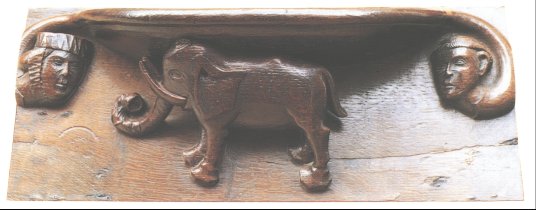
Howse points out that:
...[t]he unusual thing about the carved elephant is its naturalistic accuracy. Normally, medieval elephants are depicted as fanciful.In particular, he singles out the Aberdeen Bestiary of c.1200, which depicts "an elephant being strangled in the coils of a marvellous, elongated purple dragon with red wings":

He suggests that the Exeter misericord may have been inspired by "the only drawing made by an Englishman of the 13th century who had seen an elephant", namely "Matthew Paris (1200-59), an engaging figure, a gifted chronicler and artist and an endlessly interested observer".
Paris was fascinated by an elephant that King Louis IX of France had sent as a gift to King Henry III of England, and produced two surviving drawings of the animal, one of which includes its keeper, "Henricus de Floy", drawn in outline:
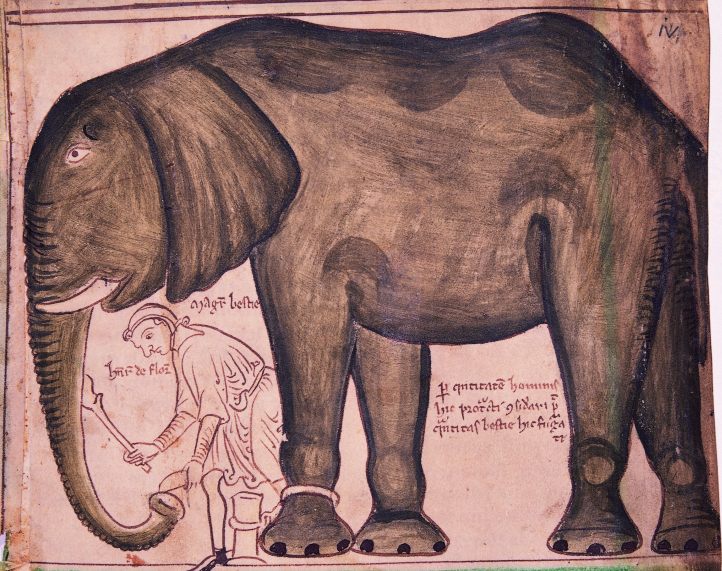
What is significant about both Paris' picture and the Exeter misericord is that they depict the elephant's ears correctly (unlike the picture from the Aberdeen Bestiary), and include knees low down on the elephant's legs, in contrast to the medieval bestiaries which depicted elephants without knee-joints. This leads Howse to recount the following tale of medieval beliefs about elephants, and the spiritual lesson they drew from this:
[A]ccording to the sources on which bestiaries drew, the elephant has no leg joints, and sleeps leaning against a tree. Hunters in India were said to saw partly through a tree so that when the elephant leant on it, the beast would fall and be unable to get up again.In the light of that little parable, the fact that elephants do in fact have knees comes as something of a disappointment - like discovering that pelicans don't in fact feed their young with their own blood, a belief that led to the pelican becoming a popular Christian symbol in the medieval church.
When a fallen elephant trumpeted in alarm, and its fellows gathered around, then neither 12 elephants together nor one great elephant could raise it from the ground, but only a small elephant using its trunk. This characteristic was moralised by the explanation that neither the old law nor the 12 prophets could raise a fallen sinner, but only the power of the meek and humble Christ.
Update: One reason I like that image of the fallen elephant being raised by the small elephant is the total helplessness of the fallen elephant. This picture excludes any notion of God "not withholding his grace from those who do what lies within their power", and provides yet another reminder of how, despite the errors that crept in during the middle ages, God never withdrew his gospel from the church.
Saturday, April 01, 2006 AD
One of my favourite sites at the moment is Gina Trapani's personal productivity blog, Lifehacker (though something very odd seems to have happened to the home page at the moment, full of stories about zombies - oh, hang on, just spotted the date. My bad.)
Anyway, in this week's non-April 1st edition of her regular "Geek to Live" column on the site, Ms Trapani gives some tips on How to deal with Internet Meanies:
Mercifully this isn't a problem I've ever really had to face on this site, but it was still an interesting read, and hopefully will be useful to some people who encounter this issue more frequently. Yes, that means you, Michael. ;-)
Anyway, in this week's non-April 1st edition of her regular "Geek to Live" column on the site, Ms Trapani gives some tips on How to deal with Internet Meanies:
There’s something about the feeling of anonymity on the Internet that can turn otherwise reasonable, pleasant people into complete blockheads. Given an open, free, global network to communicate, people use it to rant, rave, flame and complain. We’ve all done it.Her suggestions include: step away from the computer; separate the hate from the message (or in other words, perhaps that was a pretty lame post, now you think about it); grow a thick skin.
But when YOU are the target of an insulting post or sharply-worded email, quite frankly, it can really suck. Today I’ve got some strategies for dealing with Internet Meanies: those faceless virtual bullies who take pleasure in shooting other people down from the safety of their keyboards.
Mercifully this isn't a problem I've ever really had to face on this site, but it was still an interesting read, and hopefully will be useful to some people who encounter this issue more frequently. Yes, that means you, Michael. ;-)


