
Tuesday, May 31, 2005 AD
 Number one in the UK on my date of birth: "Cum on Feel the Noize" by Slade (much cooler than the US #1 in the same week: "Killing Me Softly With His Song" by Roberta Flack).
The same site claims your "life's theme song" is the No.1 on your 18th birthday. Mine is "Do the Bartman" by The Simpsons. Say it ain't so! (The US #1 on my 18th birthday was "All The Man I Need" by Whitney Houston. I shall forebear from comment.)
From This Day in Music, via Pr Stiegemeyer, whose date-of-birth song was "Get Back" by The Beatles (which is pretty cool, I'll grant you).


Friday, May 27, 2005 AD
 |
A top scientist (R) taking the credit for work done by his research student (L). |
One that I greatly enjoyed when it was published in the Guardian in about 1997, and have kept meaning to search out from time to time ever since, is the following guide to terminology used in scientific papers (which I've now found here):
A Guide To Effective Scientific Communication
"It has long been known."
I haven't bothered to look up the reference.
"It is believed."
I think.
"It is generally believed."
A couple of other guys think so too.
"It is not unreasonable to assume."
If you believe this, you'll believe anything.
"Of great theoretical importance."
I find it kind of interesting.
"Of great practical importance."
I can get some mileage out of it.
"Typical results are shown."
The best results are shown.
"Three samples were chosen for study."
The others didn't make sense, so we ignored them.
"The four hour sample was not studied."
I dropped it on the floor.
"The four hour determination may not be significant."
I dropped it on the floor but scooped most of it up.
"The significance of these results is unclear."
Look at the pretty artifact!
"It has not been possible to provide definitive answers."
The experiment was negative, but at least I can publish the data somewhere.
"Correct within an order of magnitude."
Wrong.
"It might be argued that..."
I have such a good answer for this objection that I shall now raise it.
"Much additional work will be required."
This paper isn't very good, but neither are all the others in this miserable field.
"These investigations proved highly rewarding."
My grant is going to be renewed.
"I thank X for assistance with the experiments and Y for useful discussions on the interpretation of the data."
X did the experiment and Y explained it to me.
Tuesday, May 24, 2005 AD
 Further to my previous post on the new edition of the Book of Concord, Concordia, and my later post on other forthcoming goodies from CPH, CPH have now put a sample PDF (532Kb) on their website. It looks very attractive indeed, with helpful notes and some fascinating woodcuts.
And "Hats off!" to CPH, who have generously extended an additional "mission discount" to members of the Evangelical Lutheran Church of England, which means that ELCE members should be able to pick up a copy for about a tenner (don't quote me on that, though - think some of the details re postage are still to be hammered out). Any ELCE members interested in this should speak to their pastor (or, for those churches currently without a pastor, whoever your main point of contact is with Central Office, I guess).
(Anyone else in the UK who wants a copy at that price - email me and I'll see what we can do. Unless someone from CPH slaps me down on this, I don't see why a "mission discount" shouldn't extend to non-Lutherans in this very un-Lutheran - no, let's be optimistic; pre-Lutheran ;-) - land. Bishops of Durham qualify for a free copy.)
Update: More samples now available, including examples of the colour plates. See the various links at www.cph.org/concordia.
Rather than try to compete with Love and Blunder for cute pictures of offspring, thought I'd just direct y'all to my new Flickr account, where you can view photographs of our two delightful boys. This will also cater for anyone with a burning desire to see what your correspondent looks like (cue precipitous drop in my site statistics and Bloglines subscriber numbers...).
Sunday, May 22, 2005 AD
 Interesting discussion over at iMonk and in the Boar's Head Tavern on the question of why St Paul has so little to say about the earthly life, ministry and teachings of Jesus.
I always feel a little uneasy when this sort of discussion comes up, because so many people have sought to drive a wedge between Jesus and St Paul - to try to get at the "real teachings" of Jesus the wandering Galilean preacher, before that nasty old S(i)t(h) Paul came along and turned a simple faith of good works and general niceness into some dogmatic religion of absolutes.
For anyone who still has any sympathy with that suggestion, I recommend reading CS Lewis's introduction to JB Phillips "Letters to Young Churches", in which Lewis points out that this is precisely the wrong way round ("All the most terrifying texts come from the mouth of our Lord: all the texts on which we can base such warrant as we have for hoping that all men will be saved come from St Paul"), before going on to observe that:
In the earlier history of every rebellion there is a stage at which you do not yet attack the King in person. You say: "The King is all right. It is his ministers who are wrong. They misrepresent him and corrupt all his plans – which, I’m sure, are good plans if only the ministers would let them take effect." And the first victory consists in beheading a few ministers: only at the later stage do you go on and behead the King himself.But, that said, the iMonk's question is still a legitimate and interesting one. I can't claim any scholarly expertise to answer this one, but a couple of thoughts did occur to me based on the first couple of lectures on Romans by (no groaning at the back there!) NT Wright, which I was listening to yesterday. (You should count yourselves lucky I couldn't find an NT Wright angle to Revenge of the Sith.)
In the same way, the nineteenth-century attack on St. Paul was really only a stage in the revolt against Christ. Men were not ready in large numbers to attack Christ himself. They made the normal first move - that of attacking one of his principal ministers. Everything they disliked about Christianity was therefore attributed to St Paul.
It was unfortunate that their case could not impress anyone who had really read the gospels and the epistles with attention: but apparently few people had, and so the first victory was won. St. Paul was impeached and banished and the world went on to the next step – the attack on the King himself.
Two points from these lectures that seem particularly relevant to this question are:
1. The nature of St Paul's extant writings
As Wright points out, we don't have St Paul's statement of his systematic theology; we don't have his diaries; we don't have his own projection of what his words would mean to us today. We have letters written to churches in particular situations: churches that had, in many cases, been founded by St Paul, but even if they hadn't, someone had founded them. These were all existing churches.
In the course of the apostolic preaching that led to the foundation of the first churches, it is likely that the person, life and teachings of Jesus would have featured more highly than in the letters: the argument being that the four Gospels then represent a written record of what had previously been taught orally, and now needed to be committed to paper before the original witnesses died.
The letters, on the other hand, generally address only those points that needed to be addressed by those means: areas where churches were in dispute, or were falling into error. It may be that the absence of references to Jesus' life and ministry tells us nothing more than that these were not doubted or disputed to any significant extent within the early church.
2. The place of Jesus in the teachings of St Paul
However, another reason for the absence of references, might be that, for St Paul, the earthly life and ministry of Jesus were relatively unimportant compared with His death and resurrection.
Wright argues that the importance of the Damascus Road experience for St Paul was not that it taught him to seek to be justified by faith rather than by works; not even that it showed him that he had been wrong about Jesus, and that Jesus had in fact risen from the dead; but that it demonstrated to Paul that God had done for Jesus in history what He had promised to do for Israel at the end of history.
The resurrection of Jesus proved that He was the one in whom God's purposes for the nation of Israel had been fulfilled: that He was Israel personified; that he was the Messiah. The resurrection of the righteous was expected to take place at the end of the age, but the resurrection of Jesus showed that the new age had now arrived, in a way that overlapped with the old age rather than being a sudden, one-off transition as had previously been expected.
But this led Paul to draw one very important conclusion. According to the OT prophets. one of the characteristics of the new age, the coming of God's kingdom at the end of history, was that this was the time when the Gentiles would finally be blessed, and brought into God's kingdom in fulfilment of God's promise to Abraham that "in you all the nations of the earth will be blessed".
But if the new age had now arrived, in the person of the crucified and risen Jesus Christ, then that meant that the time for the salvation of the Gentiles had also arrived. Hence this led St Paul to his particular ministry as the apostle to the Gentiles, and the insistence throughout his ministry on the complete inclusion in the church of both Jew and Gentile on an equal basis: namely, by faith in the God who had raised Jesus Christ from the dead.
So any absence of references to Jesus' life and ministry in St Paul's writings has to be set in the context of Paul's constant, burning desire to proclaim to Jews, Gentiles and "the new race" of Christians that the death and resurrection of Jesus had ushered in the new age in which the dividing wall of hostility between Jew and Gentile had finally been smashed.
That doesn't fully answer iMonk's question, but I hope it at least helps establish a context in which the absence of references to Jesus' life, ministry and teachings is less disturbing than it might sometimes be made to appear.
The spectacle presents itself as something enormously positive, indisputable and inaccessible. It says nothing more than "that which appears is good, that which is good appears". The attitude which it demands in principle is passive acceptance which in fact it already obtained by its manner of appearing without reply, by its monopoly of appearance. - Guy Debord, The Society of the SpectacleBest comments I've come across yet on Revenge of the Sith are over at Bulbous Blog, where Peter Roberts critiques the more negative comments made by his older brother, Al "40 Bicycles" (as Peter puts it, "Ally cannot see the space for the ground. THE WHOLE POINT OF THE FILM WAS SPACE AND YOU DIDN'T MENTION IT ONCE!!!").
He goes on to argue that this was the best Star Wars film of all, because:
they didn't have too much of that stupid storyline, we got to see plenty of what really mattered... Space. Call me shallow, but when a film is called Star Wars, ground scenes should be secondary.That's certainly George Lucas' philosophy, of course: cool spaceships cutting through hyperspace = good; characterisation, dialogue, plot coherence = erm, secondary.
A couple of particularly good observations in Peter's write-up. First, concerning the change in spaceship design as the film progressed (I was also interested to come across the word "greeble" for the first time):
The transition at the end of the film from 21st century futuristic designs to the 70s designs of the original trilogy is quite funny, though it is more convincing than you might expect.This development - though driven largely by the need (i) to fill the prequels with really cool spaceships that make the most of modern CGI techniques; and (ii) nevertheless to ensure a credible transition to the original films - ends up being a very effective means of symbolising the descent from a golden age into the abyss of the Sith Empire, like the transition in human history from the Bronze Age to the Iron Age.
Peter also nails one of the key moments in the film (and apologies to those for whom "Anakin turns to the Dark Side" constitutes a spoiler):
The scene with Anakin turning to the dark side was extremely unconvincing. Obviously, this was a bit disappointing as the whole film revolves around this point. It seemed like he didn't really want to join the dark side, but he was sort of thinking 'Blow this for a lark' or 'meh, I'll join the dark side'. There wasn't a very convincing inner struggle.Myself? Thought it was the best of the prequels, and probably on a level with "Jedi". It was a great spectacle, very exciting, swept you along, but then much the same could be said about Fascism (and, indeed, George Lucas's stylistic debt to Leni Riefenstahl has been frequently remarked upon), and even while watching it - and enjoying it tremendously - it all felt a bit hollow.
That probably won't stop me watching it again when it comes out on DVD, but when it comes down to it, give me just plain old vanilla 1977-vintage "Star Wars" any day.
And as for "Only a Sith deals in absolutes!": double meh.
(Also on Star Wars: Mark Steyn's reviews of Episodes IV, I and II are essential reading.)
Friday, May 20, 2005 AD
My series of NT Wright posts is clearly having an effect: the Bishop of Durham is now being tipped as a front-runner to succeed Dr David Hope as Archbishop of York.
Just think how disappointed they'll be when they find out about Pr Joel Humann's jammie dodger-fuelled coup in recruiting Dr Wright to head up the new North of England Diocese of the ELCE...
But seriously, folks, sending Tom Wright to York would be a very exciting appointment (not least since my uncle sings in the choir there, so I'd have a fighting chance of maybe getting to a service where Abp Wright was preaching). It'd be the most exciting and inspiring Church of England appointment since - well, since they appointed the current Bishop of Durham.
Just think how disappointed they'll be when they find out about Pr Joel Humann's jammie dodger-fuelled coup in recruiting Dr Wright to head up the new North of England Diocese of the ELCE...
But seriously, folks, sending Tom Wright to York would be a very exciting appointment (not least since my uncle sings in the choir there, so I'd have a fighting chance of maybe getting to a service where Abp Wright was preaching). It'd be the most exciting and inspiring Church of England appointment since - well, since they appointed the current Bishop of Durham.
In his lecture, The Paul of History and the Apostle of Faith, NT Wright at one point discusses the tendency of theologians and other Christians to project contemporary debates and disagreements onto the struggle between St Paul and first-century Judaism. He argues that:
What made me laugh was Wright's witheringly accurate observation that:
The tradition of Pauline interpretation has manufactured a false Paul by manufacturing a false Judaism for him to oppose. Nor, it appears, is this a chance mistake. It seems to be a subtle variation on the theme of seeing one’s own reflection at the bottom of a deep well.The classic example, Wright argues, is the projection of the Reformation divide between Catholic and Protestant back into Galatians. But he cites other examples: for example, the German idealists "cast Paul and the Jews in the roles of pure spirit and outward religion", while the likes of Bultmann saw in them "the contrast of authentic existence and the anxious struggle for self-understanding and self-justification".
What made me laugh was Wright's witheringly accurate observation that:
English evangelicals have tended to see the Jews as the establishment figures, the liberal or high-church bishops and theologians, with Paul as the evangelical underdog who wins through in the end, while (of course) keeping his nose clean from charismatic excesses within his own camp.Very funny, and completely spot-on. I for one have to plead guilty to falling into that trap on many occasions.
Thursday, May 19, 2005 AD
Following on from my introductory post about NT Wright yesterday, a closer look at the essay I mentioned on The Shape of Justification.
In this, Wright gives a threefold account of justification: future, past and present. Each aspect involves a declaration made by God by means of an event, which we can summarise as follows:
FUTURE
Declaration: "The one true God will finally judge the whole world," says Wright. "God's vindication of these latter on the last day is his act of final 'justification'". There are two aspects to this declaration:
PAST
"Moving from the future to the past," continues Wright, "God's action in Jesus forms Paul's template for this final justification."
Declaration: Jesus was faithful to death, and "God has now declared decisively that he is the Son of God, the Messiah, in whom Israel's destiny has been summed up".
Event: The event in which (and by which) this declaration was made "was, of course, the resurrection of the crucified Jesus", which for Paul was "the evidence that God really had dealt with sin on the cross" and that God had "accomplished what had been promised to Abraham, and 'what the law could not do'".
PRESENT
Declaration: Our present justification is thus a declaration made by God now in anticipation of the final, definitive declaration that He will make in the future, based on His past accomplishment in Christ. Again, this present declaration has two aspects:
Now you see why I said that Wright is "more Lutheran than he thinks he is". Our pastor suggested that when Wright refers to "Lutherans", he has in mind German state-church Lutherans in the tradition of Bultmann. Also, Wright seems to be under the impression that Luther's focus was on an individual's decision rather than on God's declaration in Baptism (he says as much in a lecture our pastor heard: one of the ones here, I think). Our pastor's suggestion is that Wright could well find himself in greater sympathy with confessional Lutherans than he thinks.
(Now, if only we could think of a confessional Lutheran of sound exegetical training and with ready access to Durham, to act as our ambassador to the court of the Prince Bishop. Hmmm... any suggestions? Maybe someone with time on his hands after giving up blogging...).
And equally, perhaps confessional Lutherans may find Wright more congenial than we might expect (certainly this confessional Lutheran has, at least so far), once we get past the irritating rhetorical sideswipes at some imaginary Luther of Wright's own creation, and his apparent unawareness that any sort of "Lutherans" exist other than the ahistorical existentialists he meets at Porvoo Communion get-togethers.
In this, Wright gives a threefold account of justification: future, past and present. Each aspect involves a declaration made by God by means of an event, which we can summarise as follows:
FUTURE
Declaration: "The one true God will finally judge the whole world," says Wright. "God's vindication of these latter on the last day is his act of final 'justification'". There are two aspects to this declaration:
- First, it is a legal declaration that those vindicated by God at the judgment are "righteous" (and that those condemned by Him are "guilty").
- Secondly, however, is a family, or covenantal, aspect to this declaration. "When God, as judge, finds in favor of people on the last day, they are declared to be part of this family".
PAST
"Moving from the future to the past," continues Wright, "God's action in Jesus forms Paul's template for this final justification."
Declaration: Jesus was faithful to death, and "God has now declared decisively that he is the Son of God, the Messiah, in whom Israel's destiny has been summed up".
Event: The event in which (and by which) this declaration was made "was, of course, the resurrection of the crucified Jesus", which for Paul was "the evidence that God really had dealt with sin on the cross" and that God had "accomplished what had been promised to Abraham, and 'what the law could not do'".
PRESENT
Declaration: Our present justification is thus a declaration made by God now in anticipation of the final, definitive declaration that He will make in the future, based on His past accomplishment in Christ. Again, this present declaration has two aspects:
- A lawcourt image: justification is "God's declaration that the person is now in the right, which confers on them the status 'righteous'".
- A family/covenantal image: "This present declaration constitutes all believers as the single people, the one family, promised to Abraham".
Sometimes the "family" image of justification is presented as an alternative to the "lawcourt" image, but as Wright says, "Membership in this family cannot be played off against forgiveness of sins: the two belong together."
The event in the present which corresponds to Jesus' death and resurrection in the past, and the resurrection of all believers in the future, is baptism into Christ. Baptism is not, as some have supposed, a 'work' which one 'performs' to earn God's favour. It is, for Paul, the sacrament of God's free grace. Paul can speak of those who have believed and been baptised as already 'saved', albeit 'in hope'.And before anyone thinks that Wright has in mind here some Reformed notion of a "spiritual", "inner" baptism of which "water baptism" is merely a covenantal symbol, his lecture on "The Paul of History and the Apostle of Faith" (PDF) makes it clear that he is talking about the wet version of baptism:
The Messiah’s people, like Moses’ people in 1 Corinthians 10, are a visible community entered by a real (and not a metaphorical) passage through water.Returning to "The Shape of Justification", Wright says towards the end:
...the classic Pauline way in which God makes this declaration, stating publicly and visibly that this person is indeed within the family, is through baptism.While Wright goes on to point out, quite correctly, that "in the situation of primary evangelism", baptism is saying "in dramatic action what God has in fact said the moment someone has believed", the key point here is that it is the public, visible, watery baptism that Wright identifies as the event by which God declares us publicly, visibly "righteous" in His sight, and a member of the family of all those who have been similarly declared righteous in the waters of baptism.
Now you see why I said that Wright is "more Lutheran than he thinks he is". Our pastor suggested that when Wright refers to "Lutherans", he has in mind German state-church Lutherans in the tradition of Bultmann. Also, Wright seems to be under the impression that Luther's focus was on an individual's decision rather than on God's declaration in Baptism (he says as much in a lecture our pastor heard: one of the ones here, I think). Our pastor's suggestion is that Wright could well find himself in greater sympathy with confessional Lutherans than he thinks.
(Now, if only we could think of a confessional Lutheran of sound exegetical training and with ready access to Durham, to act as our ambassador to the court of the Prince Bishop. Hmmm... any suggestions? Maybe someone with time on his hands after giving up blogging...).
And equally, perhaps confessional Lutherans may find Wright more congenial than we might expect (certainly this confessional Lutheran has, at least so far), once we get past the irritating rhetorical sideswipes at some imaginary Luther of Wright's own creation, and his apparent unawareness that any sort of "Lutherans" exist other than the ahistorical existentialists he meets at Porvoo Communion get-togethers.
Wednesday, May 18, 2005 AD
 With some trepidation, I've just started checking out NT Wright on St Paul.
 My established line with Wright, ever since my Reformed days, was "There's 'good' Wright (on the historical Jesus) and there's 'bad' Wright (on St Paul and justification), but overall it's simply splendid that he is Bishop of Durham". This spared me the trouble of actually reading any of his stuff, other than his book Who Was Jesus?, which I read shortly after becoming a Christian, and which did a lot to deliver me from the nonsense I'd been reading by John Shelby Spong on that subject (Wright also demolishes Barbara Thiering and AN Wilson in the same book).
However, our pastor thinks a lot of Wright - and indeed, I suspect there may be more than a tinge of Wrightian influence when our pastor starts preaching on Romans, which is coming up in the lectionary - and since I think a lot of our pastor, that's enough for me to give Wright another look. Besides, you have to respect a man who can come out with a lecture title as witty and provocative as "The Paul of History and the Apostle of Faith" (PDF).
And, gosh, isn't there a lot of it? I've started working my way down the left-hand column of the table on the NT Wright Page, and found plenty of interesting material. Being one for plunging in at the deep end, I've also reserved a copy of The New Testament and the People of God from the local library.
I've also downloaded Wright's lecture series on "Romans in a Week" (or at least, as many as are currently available), and will hopefully find the time to listen to these. Certainly his introduction in the first five or ten minutes of the first lecture was very engaging.
One article linked from the NT Wright Page, on The Shape of Justification, seems to provide a reasonably concise and introductory summary of Wright's position, and certainly one that sums up what I've (so far) found to be good and not so good. (Yes, we still have "good" Wright and "bad" Wright, but the boundary between the two may need shifting somewhat).
My initial perception is that he's more Lutheran than he thinks he is. Will try to post more on this article later today or else tomorrow.
 Today is the 25th anniversary of the death of Ian Curtis, lead singer of Joy Division (precursor to New Order). The BBC has a number of interesting items relating to this:
- BBC News: Remembering Joy Division singer Curtis
- (Not your grandfather's) Radio 2: an item about Joy Division's only hit, Love Will Tear Us Apart, including a chance to hear the song. And also to hear part of an "oddly jaunty" cover by (ye gods!) Paul Young.
- 6 Music devotes pretty much the entire day to its "Transmission" tributes (which can be heard online using the links provided).
Tuesday, May 17, 2005 AD
My mild-mannered alter-ego J0hn H4lt0n has a new article up at Old Solar, entitled "Why do you want to know?": God's two answers to every question.
The article was prompted by some of the talks at the London Men's Convention on Saturday, on "Biblical Answers to Tough Questions" (or was it "Tough Answers to Biblical Questions"? Either way...). I'm also hoping to post something before too long based on the "brilliant" John Stott address to which I refer in the article, which was the highlight of a generally worthwhile and interesting day.
I enjoyed the Convention much more than last year. This is partly because we were sat some way further back from the band (so the noise didn't make my ears bleed this time) and at right-angles to them (so I didn't need to get distracted/irritated by the sight of the band really digging that funky groove, man; *sigh*). But mainly it's because the overall standard of the talks was a lot higher (though, as my OS article points out, we still tended to get either Gospel, or Law, on any given topic, rather than a "proper distinction" of the two).
(Note for US readers for whom the words "London Men's Convention" conjures up images of a UK version of Promise Keepers: the LMC has always focussed almost entirely on Bible teaching from a conservative evangelical perspective, along with encouraging "men's ministry" in local churches, rather than being a revivalistic "male bonding" exercise. This distinction is hopefully pretty clear from the LMC's website.)
The day was also marked by the remarkable occurrence of a Lutheran being outdrunk by a Baptist. I met up with a group from our previous church for lunch, and one of that number managed to get through two pints of London Pride (that's a beer, by the way, not a campaigning group for gay rights) in the alloted interval, while I only managed one-plus-a-quick-half. No doubt this shameful admission on my part will get me thrown off the Purpose Driven Drinking blog. *double sigh*
The article was prompted by some of the talks at the London Men's Convention on Saturday, on "Biblical Answers to Tough Questions" (or was it "Tough Answers to Biblical Questions"? Either way...). I'm also hoping to post something before too long based on the "brilliant" John Stott address to which I refer in the article, which was the highlight of a generally worthwhile and interesting day.
I enjoyed the Convention much more than last year. This is partly because we were sat some way further back from the band (so the noise didn't make my ears bleed this time) and at right-angles to them (so I didn't need to get distracted/irritated by the sight of the band really digging that funky groove, man; *sigh*). But mainly it's because the overall standard of the talks was a lot higher (though, as my OS article points out, we still tended to get either Gospel, or Law, on any given topic, rather than a "proper distinction" of the two).
(Note for US readers for whom the words "London Men's Convention" conjures up images of a UK version of Promise Keepers: the LMC has always focussed almost entirely on Bible teaching from a conservative evangelical perspective, along with encouraging "men's ministry" in local churches, rather than being a revivalistic "male bonding" exercise. This distinction is hopefully pretty clear from the LMC's website.)
The day was also marked by the remarkable occurrence of a Lutheran being outdrunk by a Baptist. I met up with a group from our previous church for lunch, and one of that number managed to get through two pints of London Pride (that's a beer, by the way, not a campaigning group for gay rights) in the alloted interval, while I only managed one-plus-a-quick-half. No doubt this shameful admission on my part will get me thrown off the Purpose Driven Drinking blog. *double sigh*
The discussion in the comments to my post on Anglican Evangelicals has turned to the subject of the ethnicity of yer typical Sydney Anglican, and the contrast that is often drawn between yer cool, rational, northern European Protestant types, and yer swarthy, hot-blooded, excitable southern Europeans.
Indeed, what prompted FDN's comment was my own implicit drawing on this same contrast in a recent post relating to Roman Catholicism (though to be honest it hadn't occurred to me that I was making an "ethnic allusion" at the time, since I am, like, actually, y'know, a European, so had thought this was all "in-house" stuff, like a midwesterner talking about snooty New Englanders or swaggering Texans).
Anyway, this got me thinking about the question of what "Protestantism" (using the term here to include Lutheranism) would have looked like if it had taken root in southern Europe at the time of the Reformation. I once came across the point - alas, I cannot for the life of me remember where - that the perception that Protestantism is "northern European" in temperament (cool, rational, a bit repressed) whereas Roman Catholicism is "southern European" (with all the opposite attributes) is really just an accident of history and geography.
It was pointed out that you only need to look at the contrasting attitudes towards sex among Irish or Scottish Catholics as opposed to Italian or Spanish Catholics to see that there could have been just as great a range of temperaments and attitudes within Protestantism had it established itself beyond the temperate-to-chilly climes of northern Europe.
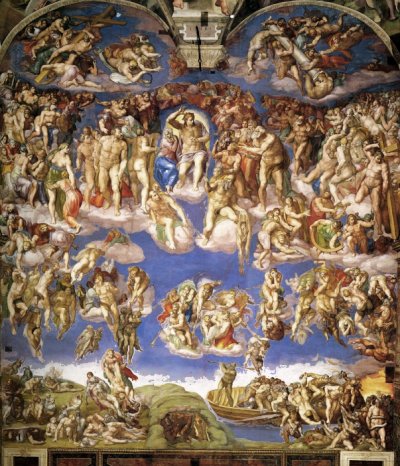 So what would a southern-European Lutheranism, say, have looked like? Well, one possible suggestion can be found in the picture to the right: Michelangelo's Last Judgment, from the Sistine Chapel (click the image, or here, for a larger version in a new window).
An evangelical friend of ours told us a fascinating story recently about this painting, of which they had a poster on display in their house. Next to Christ, in the centre of the painting, can be seen a seated figure of the Virgin Mary. Apparently, Michelangelo had originally intended to have Mary at the bottom of the picture, with her arms pointing upwards, symbolising that is was through Mary that we would go to Christ: in other words, a pictorial representation of Mary as the Mediatrix of all the Graces.
However, as Michelangelo worked on the painting (1534-41), he became increasingly aware of Lutheran teachings making their way over the Alps. These teachings placed much greater emphasis on Christ alone, and accordingly Christ was made more central in the picture. While Mary is still prominent (as well she might be), there is no suggestion of her acting in any way as a "mediatrix" or "co-redemptrix" on our behalf.
I'd be interested to know if anyone else has come across this story. I've not been able to find any corroboration, and am not sure where our friend came across the story. But if there is any truth at all in the story, it does provide an intriguing hint of what an Italian Lutheran aesthetic might have looked like.
Indeed, what prompted FDN's comment was my own implicit drawing on this same contrast in a recent post relating to Roman Catholicism (though to be honest it hadn't occurred to me that I was making an "ethnic allusion" at the time, since I am, like, actually, y'know, a European, so had thought this was all "in-house" stuff, like a midwesterner talking about snooty New Englanders or swaggering Texans).
Anyway, this got me thinking about the question of what "Protestantism" (using the term here to include Lutheranism) would have looked like if it had taken root in southern Europe at the time of the Reformation. I once came across the point - alas, I cannot for the life of me remember where - that the perception that Protestantism is "northern European" in temperament (cool, rational, a bit repressed) whereas Roman Catholicism is "southern European" (with all the opposite attributes) is really just an accident of history and geography.
It was pointed out that you only need to look at the contrasting attitudes towards sex among Irish or Scottish Catholics as opposed to Italian or Spanish Catholics to see that there could have been just as great a range of temperaments and attitudes within Protestantism had it established itself beyond the temperate-to-chilly climes of northern Europe.
So what would a southern-European Lutheranism, say, have looked like? Well, one possible suggestion can be found in the picture to the right: Michelangelo's Last Judgment, from the Sistine Chapel (click the image, or here, for a larger version in a new window).An evangelical friend of ours told us a fascinating story recently about this painting, of which they had a poster on display in their house. Next to Christ, in the centre of the painting, can be seen a seated figure of the Virgin Mary. Apparently, Michelangelo had originally intended to have Mary at the bottom of the picture, with her arms pointing upwards, symbolising that is was through Mary that we would go to Christ: in other words, a pictorial representation of Mary as the Mediatrix of all the Graces.
However, as Michelangelo worked on the painting (1534-41), he became increasingly aware of Lutheran teachings making their way over the Alps. These teachings placed much greater emphasis on Christ alone, and accordingly Christ was made more central in the picture. While Mary is still prominent (as well she might be), there is no suggestion of her acting in any way as a "mediatrix" or "co-redemptrix" on our behalf.
I'd be interested to know if anyone else has come across this story. I've not been able to find any corroboration, and am not sure where our friend came across the story. But if there is any truth at all in the story, it does provide an intriguing hint of what an Italian Lutheran aesthetic might have looked like.
Friday, May 13, 2005 AD
 There certainly seem to be some good things on the way from CPH. Here are some forthcoming publications that look very worthwhile indeed:
- Concordia, the "Reader's Edition of the Book of Concord" mentioned in my earlier post. List price $29.99, but available for $20.00 during 2005.
Don't miss the FAQs about the Book of Concord that I mentioned before, or this picture of the cover of the new book. Looks very attractive. - A new pamphlet edition of the Augsburg Confession (PDF), using the historical introductory materials from "Concordia". $8.99 for a pack of ten copies. The ELCE is apparently planning to buy a stack of these so that each ELCE member can be given a copy, which is a great idea.
- A reformatted edition of the Small Catechism with Explanation: Revd Paul McCain says that CPH are "typesetting it in a much more attractive format, and commissioning new art for it, and coming out with both bonded and genuine leather editions. Those leather editions will have the art in four color. So that will be a nice thing when it is available."
However, for UK readers interested in learning more about Lutheranism, please note that the current edition is currently selling on Amazon.co.uk for the absurd price of £4.19. While you're at it, buy Gene Veith's "Spirituality of the Cross" for £4.71. You will not regret either purchase. - Perhaps a slightly more "niche" publication this: a properly typeset and laid-out version of Dr Friedrich Bente's "Historical Introduction to the Lutheran Confessions", previously only available in what I gather is horrible 6-point, two-column text as part of the Concordia Triglotta edition of the BoC.
"While it may be a bit old and may be a bit strident for some, it is very faithful to our Confessions and does not mince words about the errors of the times", writes Revd McCain. I should point out, however, that my pastor howled with anguish at the very mention of this work, and translated Revd McCain's description as "it's out of date and no-one will want to buy it". So there's a recommendation for you. ;-)
And if you're wondering what the illustration to this post is, it's another fine product available now from CPH, for those of you who can't wait for the yet-to-be-published items listed above: a Martin Luther bobble-head doll. Katie Luther is also available. Go on, you know you want to. :-D
Thanks to Revd McCain for responding so promptly to my queries about these various publications.
In the comments to my post on Gnosticism, Larry describes how Tori Amos has become the latest of many to embrace the notion that Gnosticism represents a more woman-friendly religion than creedal Christianity (apparently Amos "was particularly intrigued by the notion that Jesus' teachings had been edited down to favor the church fathers over the church mothers, diminishing the role of women and almost writing Mary Magdalene out of the story altogether").
Amos (and anyone else labouring under the delusion that Gnosticism was more friendly to women than Christianity) would do well to read Gavin White's chapter on Gnosticism that I quoted in that previous post. One section I didn't quote at the time deals with the belief that Gnosticism "had a respect for the feminine which was lacking in orthodox Christianity". But, as White writes:
Amos (and anyone else labouring under the delusion that Gnosticism was more friendly to women than Christianity) would do well to read Gavin White's chapter on Gnosticism that I quoted in that previous post. One section I didn't quote at the time deals with the belief that Gnosticism "had a respect for the feminine which was lacking in orthodox Christianity". But, as White writes:
...even some of those who promote this view agree that in Gnostic documents the male is to the female as the divine is to the human. And if the argument rests on the feminine names of certain Gnostic deities, we should look at the part they played in the Gnostic scheme of things.For many of these gods, we know nothing other than their name, but one about whom we know quite a bit is "Sophia" (the Greek name for Wisdom):
And in Gnostic thought she was the one who yearned to see the Father, and her desire having become detached it became Sophia Achemoth who was expelled from heaven and led to the formation of the world.Setting aside the question as to whether this is a fair representation of Genesis 3 and of how it functioned in the early church, White does make a very good point when he goes on to say:
This is not very different from the myth of Adam and Eve in blaming it all on a woman [Ahem. Up to a point, Lord Copper], and we are left with the conclusion that any religion of the day took it for granted that women were inferior or cursed, and worked this into their system by an appropriate myth. The Gnostics were no exception.
But there is a difference between Christianity and Gnosticism here, in that Christianity seems to have mistakenly soaked up a lot of the hostility to sex and hostility to women which were common in that era, while Gnosticism seems to have made that hostility basic to its system.As White concludes:
As in so many other respects, Gnosticism which rejected the world was actually closer to the teachings of the world than Christianity.And ain't that always the way?
Thursday, May 12, 2005 AD
Returning to early church history... sort of. Via Peter Ould's blog comes this page demonstrating that Star Wars Episode III "is really a rewriting of Early Church history, set in a sci-fi environment".
Includes Natalie Portman as Mary Magdalene (George Lucas explains: "She's a hot property right now. And I bought the rights to the character from Dan Brown, but he gets the action figure revenues") and Hayden Christensen as Origen. Plus: St Athanasius ("you can tell it's him because he's black").
And don't miss the suggestions of a sequel, when our heroes will face a foe of a greater evil than Emperor Palpatine could ever dream of attaining...
Includes Natalie Portman as Mary Magdalene (George Lucas explains: "She's a hot property right now. And I bought the rights to the character from Dan Brown, but he gets the action figure revenues") and Hayden Christensen as Origen. Plus: St Athanasius ("you can tell it's him because he's black").
And don't miss the suggestions of a sequel, when our heroes will face a foe of a greater evil than Emperor Palpatine could ever dream of attaining...
To balance my previous post, I should point out that I still have a lot of time for Anglican Evangelicalism, particularly in its Sydney-style conservative evangelical version. That is the tradition in which I returned to the Christian faith eleven years ago, and I wouldn't be where I am now - to be precise, I would still be dead in my sins, and quite possibly in a more literal way too, the way things were heading - had it not been for that sort of conservative evangelicalism.
In fact, I'm spending Saturday at the London Men's Convention, an event modelled on similar conventions in the Diocese of Sydney, and now established as one of the key events in the conservative evangelical calendar. (As well as the details on the website, there is a short Powerpoint presentation [1.1 Mb] advertising the event - y'see, Tom R, I've nothing against it in its place ;-).)
Last year's convention was a good illustration of what I still find very congenial in conservative evangelicalism: in particular, a 95%-superb piece of Law & Gospel preaching by SydAng minister Simon Manchester on how the cross of Christ brings us freedom from fear, and a very good seminar on the cross and marriage.
Unfortunately, it also included some equally vivid illustrations of what I find most aggravating in contemporary evangelicalism: an irritating (and FAR TOO LOUD) praise band, complete with bassist wearing a JCUK t-shirt (and you thought Chris Idle was making it up), and one talk that was a 100% Law-based harangue - Simon Manchester comforted us with the cross, and then [name omitted] proceeded to hit us over the head with it for an hour. As one person from my old church, a fairly recent convert (but of a sufficiently sturdy temperament to withstand the onslaught), put it: "He certainly got his point across, didn't he?".
I hadn't been planning to go this year, until the publicity materials arrived and I saw that the keynote speaker was none other than the godfather of post-war conservative evangelicalism himself, John Stott. Believe it or not, while I've read many of his books, I have never seen Stott in action, so I wasn't going to pass up this opportunity. I'll report back on how it went after Saturday.
In fact, I'm spending Saturday at the London Men's Convention, an event modelled on similar conventions in the Diocese of Sydney, and now established as one of the key events in the conservative evangelical calendar. (As well as the details on the website, there is a short Powerpoint presentation [1.1 Mb] advertising the event - y'see, Tom R, I've nothing against it in its place ;-).)
Last year's convention was a good illustration of what I still find very congenial in conservative evangelicalism: in particular, a 95%-superb piece of Law & Gospel preaching by SydAng minister Simon Manchester on how the cross of Christ brings us freedom from fear, and a very good seminar on the cross and marriage.
Unfortunately, it also included some equally vivid illustrations of what I find most aggravating in contemporary evangelicalism: an irritating (and FAR TOO LOUD) praise band, complete with bassist wearing a JCUK t-shirt (and you thought Chris Idle was making it up), and one talk that was a 100% Law-based harangue - Simon Manchester comforted us with the cross, and then [name omitted] proceeded to hit us over the head with it for an hour. As one person from my old church, a fairly recent convert (but of a sufficiently sturdy temperament to withstand the onslaught), put it: "He certainly got his point across, didn't he?".
I hadn't been planning to go this year, until the publicity materials arrived and I saw that the keynote speaker was none other than the godfather of post-war conservative evangelicalism himself, John Stott. Believe it or not, while I've read many of his books, I have never seen Stott in action, so I wasn't going to pass up this opportunity. I'll report back on how it went after Saturday.
Wednesday, May 11, 2005 AD
From the February 2005 issue of Forward in Faith's magazine New Directions ("Serving Evangelicals and Catholics seeking to renew the Church in the historic faith"), a fun and illuminating article by Christopher Idle on the question, "What is an Evangelical?".
Idle begins by describing how learned Evangelicals have made many attempts over the years to answer that question, before going on to offer a somewhat different approach:
As for church architecture, every church building has "its icons, images and focal points", and Anglican Evangelical churches are no exception:
As I've said before on a number of occasions, it is the tragedy of the Church of England that, by and large, you are forced to choose between either liturgical faithfulness and theological anarchy on the one hand (as in the Affirming Catholic church I visited while on holiday last week), or else theological faithfulness and liturgical anarchy on the other (as in the typical conservative evangelical church, as portrayed by Christopher Idle, and as described from my own experience in the first paragraph of "Step Two" in an early post on this blog in which I described my own departure from Anglicanism).
The desire to be a "JC Ryle Anglican", combining a commitment to Scriptural Christianity with a love for the historic liturgy of the church - as well as a higher view of the Sacraments than is typical among Anglican Evangelicals today - is what led to my constantly feeling out of place within Anglican Evangelicalism; to repeated bouts of "Roman Fever" (not to mention "Constantinople Snuffles"); and ultimately, by the grace of God, to unmitigated delight at discovering that it was possible to combine Evangelical faith with a strongly sacramental and liturgical approach to worship, and that one of the very few churches where I could find this in the UK was just down the road.
Not that JC Ryle would be very impressed with Lutheranism, given his trenchant views on baptismal regeneration and (especially) the Real Presence, but that's a different story...
Update: Follow-up post giving the other side of the story (esp. in its first paragraph): I [heart] Anglican Evangelicals.
Idle begins by describing how learned Evangelicals have made many attempts over the years to answer that question, before going on to offer a somewhat different approach:
This half-page does not pretend to rival or revise such searching definitions; it simply offers a snapshot of what today's evangelical looks like. Or rather, a brief slice of fuzzy film where we have been caught on CCTV for a few minutes one Sunday.Anyone who has ever spent any time in the contemporary Anglican Evangelical world will recognise the portrait that follows. Indeed, it is important to stress here that Christopher Idle is himself an Anglican Evangelical, as well as being a hymnwriter of some renown (at least one of his hymns, "Since our great High Priest, Christ Jesus", is to be included in the Lutheran Service Book), or this depiction of Evangelical life might be mistaken for the work of a hostile outsider:
Here he comes, then (we'll call him he), shuffling into church a little late, in carefully-selected clothes which may include gardening trousers and a rugby shirt or something with a snappy slogan like JCUK (signifying 'John Charles [Ryle] - UnKnown'). At the door he gratefully accepts the bundle of leaflets which represents the menu for the next 90 minutes or so. Yes, ninety; on a good morning, say 110.The service commences with "a chatty introduction of jokes for the in-crowd", before a "youngish" person makes an announcement something along the lines of the following:
"Now I want you all to stand up for 15-20 minutes while the music group strings together a series of unconnected and rather silly songs. They all go to some repetitive and banal tunes which you don't know; but not to worry because each one is much the same as the one before, and our musicians will make them sound really cool, or at least loud."Idle the hymnwriter also allows himself a waspish comment about the words, whose "main point is that we're winning. Or rather, 'I'm winning'".
As for church architecture, every church building has "its icons, images and focal points", and Anglican Evangelical churches are no exception:
[H]ere the eye-catching horizon is dominated by a large white screen, effectively blocking our view of any previously visible window or ecclesiastical furniture. Slightly lower in our vision are the drum kit, music stands, instrument cases, microphones, trailing wires and amplifiers of the band. This is a visual age and there is always something to watch.And so - after a brief sideswipe at one of my own personal bugbears, preachers singing with their hands in their pockets - we come to the content of the service, which is characterised by continued chattiness from the preacher:
Your evangelical will listen with exemplary patience to a number of gossipy mini-sermons slotted in to explain the confession, intercession and creed (if any), before the maxi-sermon for which he will need his Bible. Sometimes this is all the Bible he will get; for Psalms, Canticles, Lord's Prayer and responses are usually omitted.And what sort of a welcome can you expect from this church?:
The Ten Commandments may get an occasional mention (see also 'Prayer Book', '39 Articles') but are never read. He may not hear much about Advent, Epiphany, Lent, Maundy Thursday, Ascension Day, Trinity Sunday or All Saints. So you need not expect any Collect of the Day. Who needs a book when you can do it all yourself and make it up as you go along?
If you're a newcomer, you will be delightedly greeted during The Peace but may be ignored afterwards unless the congregation is small. You may never find out who the people are up front, or which if any of them is the Vicar. But don't worry; most of what you need to say, sing or know will also appear as if by magic on the giant screen.While this article is lighthearted in tone, you can clearly sense Idle's genuine concern and anguish about much of what he portrays. The key reference is probably to the "JCUK" T-shirt, and Idle's interpretation of it as "JC (Ryle) UnKnown". Because what he is talking about is the death of "JC Ryle Anglicanism", in which a strongly Evangelical message was combined with a great love for the liturgical heritage of the Book of Common Prayer, and in which worship was characterised by "reverence and holy fear". And in which it would have been unthinkable to mark Maundy Thursday with a fish and chip supper.
As I've said before on a number of occasions, it is the tragedy of the Church of England that, by and large, you are forced to choose between either liturgical faithfulness and theological anarchy on the one hand (as in the Affirming Catholic church I visited while on holiday last week), or else theological faithfulness and liturgical anarchy on the other (as in the typical conservative evangelical church, as portrayed by Christopher Idle, and as described from my own experience in the first paragraph of "Step Two" in an early post on this blog in which I described my own departure from Anglicanism).
The desire to be a "JC Ryle Anglican", combining a commitment to Scriptural Christianity with a love for the historic liturgy of the church - as well as a higher view of the Sacraments than is typical among Anglican Evangelicals today - is what led to my constantly feeling out of place within Anglican Evangelicalism; to repeated bouts of "Roman Fever" (not to mention "Constantinople Snuffles"); and ultimately, by the grace of God, to unmitigated delight at discovering that it was possible to combine Evangelical faith with a strongly sacramental and liturgical approach to worship, and that one of the very few churches where I could find this in the UK was just down the road.
Not that JC Ryle would be very impressed with Lutheranism, given his trenchant views on baptismal regeneration and (especially) the Real Presence, but that's a different story...
Update: Follow-up post giving the other side of the story (esp. in its first paragraph): I [heart] Anglican Evangelicals.
Reprinted in this week's Private Eye, a (genuine) snippet from the parish newsletter for St Matthew's Church, West Ham:
Maundy Thursday, 24th March
7.30pm The Lord's Last Supper
(With fish and chips for all the family)
Tuesday, May 10, 2005 AD
Continuing with Gavin White's book, The Mother Church Your Mother Never Told You Of (see yesterday's post), this time looking at the chapter on Gnosticism:
What was the appeal of Gnosticism? First, its apparent simplicity:
Of course, while Gnosticism claimed to give a simple and clear alternative - the world is evil and was made by an evil god, and our aim is to escape the material world and return to being the happy free souls we once were - it still had to face the question of why this teaching cannot be found either in the Scriptures or the traditions of the church:
But in some respects Gnosticism was a necessary enemy for the church to face as it grew: "The church needed Gnosticism in order to reject it". And, White suggests, "perhaps every Christian needs to pass through some sort of Gnostic phase in order to outgrow it":
Gnosticism spread through the church of the second century like a computer virus. Masquerading as the real thing, it worked its way into churches all over the Mediterranean and proceeded to eat away at the Christian faith, doing untold damage until detected.White argues that Gnosticism was not a heresy, "since it was not an exaggeration or distortion of Christian doctrine", but instead "at least partly an outside body which had broken in and multiplied, at the expense of the churches on which it fed".
It was then cast out into utter darkness from which it was only brought back by nineteenth-century Liberal Protestants who thought it was liberal, which it was not, and protestant, which it was not. It was flying saucer stuff.
What was the appeal of Gnosticism? First, its apparent simplicity:
As religions go, Christianity is difficult. The material world is made by God, and it is good, but then it has gone wrong, and if it is not bad, it is certainly flawed, and human nature was good, and then was flawed, and is getting back, thanks to Jesus Christ, to a state in which it will be as good as it was and perhaps much better. The Christian is called to be in the world but not of it, to flee the world and to save it.White goes on to give what is currently a very topical illustration, when he refers to the computer Deep Thought in the Hitchhiker's Guide to the Galaxy, that was set the task of finding the answer to Life, the Universe and Everything:
If all this does correspond pretty closely to the mixture of good and evil which everyone meets in real life, it is not easy to grasp overnight, and the Christian faith requires a long process of growth.
After many years it pronounced the answer to be forty-two. This is a multiple of seven and six; in the New Testament seven is perfection or good, and six is imperfection or bad, so forty-two is a multiple of both good and bad.Furthermore, quite apart from the complications of the Christian worldview, in which the Answer is most certainly forty-two (though one day, I'm tempted to add, it will be forty-nine), Gnosticism also claimed to speak to the experience of the individual Christian, who might be finding the Christian life hard-going:
It would be far easier to have six as the answer and consider the world to be simply bad, or even to have seven as the answer and consider the world to be simply good. Gnosticism took the answer to be six.
[T]here are troughs as well as peaks in prayer and devotion. It is during one of the troughs, when all seems black, that the Christian is approached by the salesman for the product with the secret ingredient. Christianity really is easy, and it really does everything for you with little effort, and it is quite clear and simple.(Discuss, with reference to the contents of the average Christian bookshop, or the output of the average Christian TV or radio station.)
Of course, while Gnosticism claimed to give a simple and clear alternative - the world is evil and was made by an evil god, and our aim is to escape the material world and return to being the happy free souls we once were - it still had to face the question of why this teaching cannot be found either in the Scriptures or the traditions of the church:
The answer to this is easy; those closest to Christ knew that most people would not be worthy of the true knowledge (or "gnosis" in Greek) and so they kept the true knowledge for the few who could appreciate it, while providing a surface religion for the rest.So what was the appeal of Gnosticism to nineteenth-century Liberal Protestants? Basically they believed that Gnosticism represented the simple fellowships of true believers that had been swept away by their catholicising enemies, who had bound the church in rules and dogmas and then misrepresented Gnostic teachings in order to cover their tracks:
But you are clearly worthy of this true knowledge and have been selected - anyone who has received junk mail telling them they have been chosen for a chance of a tropical cruise or a new car or an electronic toothbrush will be familiar with the technique.
But the theory that Gnosticism had been distorted by its enemies could only be believed while the Gnostic writings were lost, save for odd scraps found in quotations from those determined to do them down.This train of thought came to a juddering halt when the Gnostic writings of Nag Hammadi were discovered in 1945, which revealed that:
...Gnosticism had been what its enemies had always said it was. The ideas of the fellowships of believers with their simple faith in goodness as set forth by the teacher of Galilee were swamped by the strings of passwords and names by which the initiates could gain control over heavenly beings, and be passed up the line from one to another.So what defeated Gnosticism in the early church? Usually this is credited to the "defensive works of Christian thinkers", such as Irenaeus:
Yet there is a much more likely reason why it faded. It did not work. It could not work. Like most simple systems which claim to get to the root of the matter and avoid complications, it did not get the root of the matter and it did not avoid the complications.Simply explaining away the world as evil and saying that we had been kidnapped from heaven was all very well, but people couldn't escape the fact that they "had to live in a world which was clearly a mixture of what was good and what was bad."
But in some respects Gnosticism was a necessary enemy for the church to face as it grew: "The church needed Gnosticism in order to reject it". And, White suggests, "perhaps every Christian needs to pass through some sort of Gnostic phase in order to outgrow it":
[I]t may be that each Christian finds the real thing too difficult or too slow or too demanding, and goes for some alternative with the secret ingredient, and only when that fails, returns to the painful encounter with the real thing.
 This year is the 425th anniversary of the Book of Concord, the definitive edition of the ten confessional documents of the Evangelical Lutheran Church, from the three Ecumenical Creeds of the first millennium, to the Formula of Concord of 1577.
To celebrate this event, CPH is publishing what looks likely to be a very attractive "Reader's Edition" of the Book of Concord, and as part of the publicity for this Revd Paul McCain has published a set of FAQs about the Book of Concord. These can be freely copied in their unamended form for non-commercial purposes, so I've put a copy on my longer blog.
For more information on the forthcoming "Reader's Edition" of the Book of Concord, being published to celebrate the 425th anniversary of its original publication, see here. For those who cannot wait till June, the most recent English translation of the BoC, the Kolb/Wengert edition, can be found on Amazon.com and (for the absurdly low price of £21.22 inc. P&P) on Amazon.co.uk.
Update: A picture of the front cover, and "advance praise" for the forthcoming edition can be found here. It looks like it will be a very handsome volume indeed.
Monday, May 09, 2005 AD
While on holiday last week, I had one particular triumph in the second-hand section of the SPCK bookshop in Winchester: finding a copy of Gavin White's book, The Mother Church Your Mother Never Told You Of, a short, entertaining and idiosyncratic history of the first 600 years or so of what White describes as the "One, Holy, Catholic, Apostolic and Scruffy" church.
Sadly, this book is currently out of print, as is White's earlier book, How the Churches Got to Be the Way they Are, which covers the past two centuries of Christianity. I've been looking for a copy of The Mother Church... ever since I borrowed it from our local library a good five or six years ago, so I fell upon this copy with a cry of joy that would probably have caused some alarm had anyone else been in that part of the shop at the time.
White opens by describing the two extremes that one encounters in studying early church history:
Sadly, this book is currently out of print, as is White's earlier book, How the Churches Got to Be the Way they Are, which covers the past two centuries of Christianity. I've been looking for a copy of The Mother Church... ever since I borrowed it from our local library a good five or six years ago, so I fell upon this copy with a cry of joy that would probably have caused some alarm had anyone else been in that part of the shop at the time.
White opens by describing the two extremes that one encounters in studying early church history:
Briefly, conservatives believe that "long ago" was only yesterday, and liberals that it was so far back that the people involved were barely human.White describes the effects of believing in a "once-for-all creation" of the church:
The conservative view leads to the assumption that we can quite simply put ourselves back in the place of the early Christians and think as they thought and do as they did ... Nothing much happened between the writing of the New Testament and a series of modern calamities beginning with Darwin or Freud.
Liberals take the opposite view. Time has gone so slowly. So much has happened since the days of the apostolic church that we are barely able to make guesses as to what the evidence means, or what it was to be a Christian in those days ... The evidence must be entirely reinterpreted, and the words of the apostles or fathers rewritten to show what they would have said if they had been like us. For they were primitive, and all that has come to us from their time is itself primitive and must be made new.
If we believe in a single creation period, then anything thereafter is pollution. It should be scraped off. You only have to prove that something developed in the second century, or the third, or the fourth, or last Thursday, and it is not of the real church. The real church was as it was delivered by the manufacturer, and before it was driven off.In this spirit, people often assume "that the early Christians were much better Christians than the Christians of today". However:
To assume that the early Christians were wonderful supposes that Christianity had a sell-by date, and its effectiveness became weaker with every generation.This idealisation of church history has other pastoral consequences, as contemporary Christians are continually beaten up over the contrast between them and Those Wonderful Early Christians by:
It is in something of this spirit that certain Westerners become intrigued by the Eastern Orthodox, not as real Christians living real lives in the modern world, but as if they were survivals of the apostolic age, untouched by history, like that fish long believed to be extinct but found in the nets of a Malagasy fisherman and, had it not been eaten, very disturbing to the palaeontologists.
...a generation of preachers who tell their huddled congregations that if they had real resurrection faith [like the early church] they would not only convert the neighbourhood but even pay for a new heating system.By contrast, what the New Testament and subsequent church history both tell us is that the early Christians were "a pretty scruffy lot":
Yet if the early Christians were a scruffy lot, this is hardly surprising. Had the early Christians all been super-Christians, then the Christian faith would have been only suitable for such people as scarcely exist in the real world.Just as it is a mistake to look to the early church (whether of the apostolic or post-apostolic age) as the perfect template for us today, so it is a doomed enterprise to try to find "pure Christianity", free of historical or cultural baggage:
There is no pure essence of Christianity. A religion of God-made-flesh means that the forms of Jewish life and Roman empire are going to be carried round the world. There is no other way in which Christianity could travel without ceasing to be Christianity ... Christianity does not push its way through history, it carries history with it.White packs a lot of fascinating material into the 17 chapters and 135 pages of this book, on topics ranging from Gnosticism to the Celtic church ("was there such a thing?"), and hopefully I will get round to posting more of this as I work my way through it.
Sunday, May 08, 2005 AD
The bovine revolution starts here - led by the radicalised vanguard of the Cows With Guns. Just... awesome.
Hat-tip to Revd McCain, of all people.
Hat-tip to Revd McCain, of all people.
Thanks to everyone who contributed to the discussion on my various posts relating to the Blessed Virgin Mary, and who took the time to answer the questions in my survey on this topic. Before moving on to other topics (I promise!), here's a summary of the answers given in the survey to date.
In summarising these, I have exercised autocratic and, indeed, largely arbitrary authority over the interpretation of people's responses. As the saying goes, "There are two rules. Rule one: the referee is always right. Rule two: if the referee is wrong, rule one applies."
In the first five tables, "D" means "Yes, as Doctrine"; "P" means "Yes, as Pious opinion"; "N" means "No, but others may hold it as a pious opinion"; "F" means "This is False teaching that must be rejected"; and "?" indicates "not sure" or no answer given (though in some cases I took the liberty of surmising what people's answer would be, where this was pretty obvious from their other answers).
Some people expressed reservations about the connotations carried by the English expression "Mother of God" as opposed to "Theotokos" ("God-bearer"), but only one person denied the underlying doctrine outright as false teaching.
While I answered "N" to the Immaculate Conception, on reflection I agree with Josh, the independent KJV-only Baptist (but counted as Lutheran for the purpose of these results) who answered "No, but it can be a pious opinion if it is not attached to claiming she was born without sin". Very droll. So that would tip the Lutheran answers into 6 "N" and 7 "F" rather than vice versa.
As I recall, the two "Protestants" answering "P" to this were Anglo-Catholics, who are probably grinding their teeth at being given the designation "Protestant". But I didn't want to have too many categories, and anyway, rules one and two apply here as set out above. ;-)
Not surprisingly, this attracted the most hostile response from non-Roman Catholics. On the other hand, only one Roman Catholic respondent positively stated that this ought to be made a doctrine (but they went on to say that the time wasn't right to do so).
I've taken this to mean "second-person devotion" (the Ave Maria, the Rosary, Salve Regina etc) whether in public worship or private devotion, rather than "third-person commemoration" or singing the Magnificat.
One positive outcome of this discussion for me personally has been that I have become very attached to using the evangelical commemoration of the Blessed Virgin Mary after the office in my own devotions. However, I remain of the view that the Ave Maria is pretty much beyond recovery for (Augsburg) Evangelicals, notwithstanding Luther's evangelical explanation of its pre-Reformation form as a meditation on God's grace to and through Mary.
In summarising these, I have exercised autocratic and, indeed, largely arbitrary authority over the interpretation of people's responses. As the saying goes, "There are two rules. Rule one: the referee is always right. Rule two: if the referee is wrong, rule one applies."
In the first five tables, "D" means "Yes, as Doctrine"; "P" means "Yes, as Pious opinion"; "N" means "No, but others may hold it as a pious opinion"; "F" means "This is False teaching that must be rejected"; and "?" indicates "not sure" or no answer given (though in some cases I took the liberty of surmising what people's answer would be, where this was pretty obvious from their other answers).
Theotokos
| D | P | N | F | ? | |
| Overall | 30 | 1 | |||
| Lutheran | 14 | ||||
| Roman Catholic | 6 | ||||
| Protestant | 10 | 1 |
Some people expressed reservations about the connotations carried by the English expression "Mother of God" as opposed to "Theotokos" ("God-bearer"), but only one person denied the underlying doctrine outright as false teaching.
Ever-Virgin
| D | P | N | F | ? | |
| Overall | 8 | 8 | 10 | 3 | 2 |
| Lutheran | 2 | 5 | 6 | 1 | |
| Roman Catholic | 6 | ||||
| Protestant | 3 | 4 | 2 | 2 |
Immaculate Conception
| D | P | N | F | ? | |
| Overall | 6 | 3 | 9 | 13 | |
| Lutheran | 1 | 7 | 6 | ||
| Roman Catholic | 6 | ||||
| Protestant | 2 | 2 | 7 |
While I answered "N" to the Immaculate Conception, on reflection I agree with Josh, the independent KJV-only Baptist (but counted as Lutheran for the purpose of these results) who answered "No, but it can be a pious opinion if it is not attached to claiming she was born without sin". Very droll. So that would tip the Lutheran answers into 6 "N" and 7 "F" rather than vice versa.
As I recall, the two "Protestants" answering "P" to this were Anglo-Catholics, who are probably grinding their teeth at being given the designation "Protestant". But I didn't want to have too many categories, and anyway, rules one and two apply here as set out above. ;-)
Assumption
| D | P | N | F | ? | |
| Overall | 6 | 4 | 18 | 2 | 1 |
| Lutheran | 2 | 12 | |||
| Roman Catholic | 6 | ||||
| Protestant | 2 | 6 | 2 | 1 |
Co-Redemptrix/Mediatrix
| D | P | N | F | ? | |
| Overall | 4 | 2 | 23 | 2 | |
| Lutheran | 1 | 13 | |||
| Roman Catholic | 4 | 1 | 1 | ||
| Protestant | 10 | 1 |
Not surprisingly, this attracted the most hostile response from non-Roman Catholics. On the other hand, only one Roman Catholic respondent positively stated that this ought to be made a doctrine (but they went on to say that the time wasn't right to do so).
Devotion
| Y | N | ? | |
| Overall | 10 | 20 | 1 |
| Lutheran | 2 | 11 | 1 |
| Roman Catholic | 6 | 0 | 0 |
| Protestant | 2 | 9 | 0 |
I've taken this to mean "second-person devotion" (the Ave Maria, the Rosary, Salve Regina etc) whether in public worship or private devotion, rather than "third-person commemoration" or singing the Magnificat.
One positive outcome of this discussion for me personally has been that I have become very attached to using the evangelical commemoration of the Blessed Virgin Mary after the office in my own devotions. However, I remain of the view that the Ave Maria is pretty much beyond recovery for (Augsburg) Evangelicals, notwithstanding Luther's evangelical explanation of its pre-Reformation form as a meditation on God's grace to and through Mary.


