
Saturday, September 30, 2006 AD
The Japanese don't mess about when it comes to illegally-parked bicycles.
Calls to mind the telephone messages taken by Homer Simpson when he was working as Mr Burns's PA:
Calls to mind the telephone messages taken by Homer Simpson when he was working as Mr Burns's PA:
"You have thirty minutes to move your car." "You have ten minutes to move your car." "Your car has been impounded." "Your car has been crushed into a cube." "You have thirty minutes to move your cube."


Friday, September 29, 2006 AD
I've now finished Elizabeth Kolbert's book, Field Notes from a Catastrophe, and can repeat my earlier recommendation of it. Essential reading, especially if you are still a sceptic on climate-change issues (it certainly swept away any lingering scepticism of my own).
Here is a brief summary of some of the key facts cited in Kolbert's book. What you don't get here is the additional power of some of the extrapolations being made from this data - the prospect of CO2 levels reaching 750 ppm by 2100, the disappearance of the Arctic ice cap during the summer by 2080 - as I wanted to concentrate just on what's happening right now.
Nor do you get Kolbert's blackly comic interview with Bush administration "I-speak-your-policy" machine, Paula Dobriansky ("We act, we learn, we act again" - that was her catchphrase). Nor her observation that, in most areas of scientific concern, lay people tend to be more anxious than the experts (e.g. nuclear power), whereas in climatology it is the experts who are most concerned. This is "just the facts, ma'am".
To break it up a bit, I've split the list in accordance with the two parts of Kolbert's book, "Nature" and "Man":
Nature
Here is a brief summary of some of the key facts cited in Kolbert's book. What you don't get here is the additional power of some of the extrapolations being made from this data - the prospect of CO2 levels reaching 750 ppm by 2100, the disappearance of the Arctic ice cap during the summer by 2080 - as I wanted to concentrate just on what's happening right now.
Nor do you get Kolbert's blackly comic interview with Bush administration "I-speak-your-policy" machine, Paula Dobriansky ("We act, we learn, we act again" - that was her catchphrase). Nor her observation that, in most areas of scientific concern, lay people tend to be more anxious than the experts (e.g. nuclear power), whereas in climatology it is the experts who are most concerned. This is "just the facts, ma'am".
To break it up a bit, I've split the list in accordance with the two parts of Kolbert's book, "Nature" and "Man":
Nature
- Ten hottest years on record, in decreasing order: 1998, 2005, 2003, 2003, 2004, 2001, 1997, 1995, 1999, 1990.
- In most parts of Alaska, the permafrost has warmed by three degrees fahrenheit since the early 1980s. In some parts of the state, it has warmed by nearly six degrees.
- Methane releases from the Stordalen bog in Sweden have increased by as much as 60 per cent.
- Since 1979, perennial sea ice in the Arctic has shrunk by 250 million acres (equivalent to New York, Georgia and Texas combined).
- Sea-ice depth in parts of the Arctic declined by 40 per cent between the 1960s and the 1990s.
- CO2 measurements at Mauna Koa have shown a 20 per cent increase since 1958, and now stand at 378 parts per million - compared with a preindustrial figure of 280 parts per million.
- The Greenland ice sheet (which holds enough water to raise sea levels by 23 feet) shrank at a rate of 12 cubic miles a year during the 1990s.
- The rate of flow of the Jakobshavn Isbrae ice stream in Greenland has increased from 3.5 miles per year in 1992 to 7.8 miles per year in 2003.
- The Solheimajokull glacier in Iceland has shrunk by 1,100 feet since 1996.
- The Comma butterfly's range in the UK has moved northward at a rate of fifty miles per decade since the 1970s.
- Four out of six common frog species in New York are now mating ten days earlier in each year.
- The golden toad in Costa Rica, discovered only in 1964, became extinct by 1990 after changes in precipitation patterns disrupted its mating process, from 1987 onwards.
- Civilisations and cultures whose collapse can be linked to past climate change include: the Akkadian empire, the Mayan civilisation, the Tiwanaku civilisation, the Old Kingdom of Egypt.
- The "forcing" effect on the climate of greenhouse gases is equivalent to six Christmas tree lights on every square metre of the earth's surface, burning 24x7x365.
- The Netherlands is now reversing centuries of land reclamation, allowing water to inundate much of its land - and floating houses are now on sale.
- Ice core samples from Vostok show the earth is now nearly as warm as it has been in the last 420,000 years, and the current CO2 concentration of 378 ppm is unprecedented in human history.
- Since the late 1980s, the average fuel efficiency of passenger vehicles in the US has declined by more than 5 per cent.
- China's carbon emissions are expected to overtake those of the US by 2025, including building the equivalent of over 300 one-gigawatt coal-fired power stations.
- In a year, the average American produces as much greenhouse gas as 4.5 Mexicans, 18 Indians, or 99 Bangladeshis.
- Out of 900 refereed articles on climate change between 1993 and 2003, 75% endorsed the view that climate change was partly induced by human greenhouse gas emissions. 25% (being concerned with methodology or climate history) took no position on current conditions. Number of articles disputing that human-induced climate change is occurring: zero.
- US carbon emissions are now 20 per cent higher than they were in 1990.
- Replacing a 100-watt incandescent bulb burning on the porch all night with an energy-saving bulb could reduce a family's annual electricity bill by 10 per cent.
Q. So, how worried should we be?Something more cheerful next; I promise.
A. How lucky do you feel?
Wednesday, September 27, 2006 AD
 My latest Amazon haul arrived yesterday, including Jaroslav Pelikan's Whose Bible Is It?, and (winning the award for title-of-the-decade) Elizabeth Kolbert's Field Notes from a Catastrophe.
Field Notes has been compared by many people to Rachel Carson's Silent Spring, whose warnings about the impact of pesticides and other chemicals is widely credited with having kick-started the modern environmental movement. In it, Kolbert sets out to describe evidence for climate change from around the world - the rapid melting of sea-ice and permafrost in the Arctic, the rapid northward movement of butterfly species in Britain, the extinction of a recently-discovered species of "extraordinary new toad" in Costa Rica.
As she writes (specifically in relation to species migration, but the point applies equally well to the other areas of evidence):
Any one of these changes could, potentially, be a response to purely local conditions ... The only explanation that anyone has proposed that makes sense of them all, though, is global warming.I've read the first part of the book, "Nature", and so far it is persuasive, beautifully written - and dismaying in its relentless, fact-driven description of rapid climate change happening right now. As the quote from Robert F Kennedy Jr says on the back:
Kolbert mesmerizes with her poetic cadence as she closes the coffin on the arguments of the global warming skeptics.My attention was first drawn to this book by a review in the May 2006 issue of Scientific American. The reviewer, Marguerite Holloway, is one of a number to make the Silent Spring comparison, and describes Field Notes as "powerful, clear and important". She also commends the book's "scientific authority":
Kolbert is not a scientist, but she reports regularly on science, and she may well have talked to every researcher on the planet studying global warming. There are names and characters in Field Notes that even a climate-change obsessive may not have seen in other press articles or books.Holloway also bemoans the lack of protest on environmental (and other) issues in the US:
It is strangely quiet here. Americans are also burned out on environmental catastrophism ... The problems grow, but apathy has set in.But Holloway ends her review with the hope that Kolbert's book might prove to be "this era's galvanizing text".
However, the paragraph from Holloway's review that made me determined to pick up Kolbert's book is the following:
It can get dizzying at times. Yet the enduring impression is of deep, sober, rooted authority - the same impression Silent Spring conveys. The book is a review of the scientific evidence and of the failure of the politicians we chose. The details are terrifying, and Kolbert's point of view is very clear, but there is no rhetoric of rant here. She is most directly editorial in the last sentence of the book, and by that point, she has built the case.Climate change is an issue that has suffered from an excess of "rhetoric of rant" on both sides of the debate, but - as Al Gore's film has also shown - it is one in which the most effective approach is that taken by Kolbert in Field Notes: a calm, remorseless litany of facts, presented with a "deep, sober, rooted authority", building up what Owen Gingerich has called the "coherent patterns of explanation" (as distinct from "proof") that science is concerned with.
Kolbert's book is short, well-written, less hyped than the Al Gore movie, and I strongly recommend it. For those of you who are as shallow as me, I should also point out that the UK hardback edition is a physically gorgeous object.
Tuesday, September 26, 2006 AD
Even cardinals have blogs now... lol (and yes, this is a cardinal who uses the expression "lol").
Why can't I get the music from Father Ted out of my head all of a sudden...?
Why can't I get the music from Father Ted out of my head all of a sudden...?
Monday, September 25, 2006 AD
Some interesting comments building up on my post on biofuels. Which is as good an excuse as any for blowing my own trumpet by pointing out that that post got a mention on the Financial Time's business blog. The FT's post is worth reading for a useful overview of the debate about Richard Branson's biofuel initiative.
Talking of interesting links, the latest Lutheran Carnival is up. Thanks to TK for gathering in the latest harvest of blog posts.
Talking of interesting links, the latest Lutheran Carnival is up. Thanks to TK for gathering in the latest harvest of blog posts.
Things have reached a pretty pass when I start quoting Team Pyro with approval, but I couldn't resist the following thought thrown out by C.H. Spurgeon:
We must preach the gospel so distinctly that our people know what we are preaching. "If the trumpet give an uncertain sound, who shall prepare himself for the battle?" Don't puzzle your people with doubtful speeches.Having in the past sat under some preaching that hadn't been thrown out quite as far as it should have been, I particularly enjoyed this one.
"Well", said one, "I had a new idea the other day. I did not enlarge upon it; but I just threw it out."
That is a very good thing to do with most of your new ideas. Throw them out, by all means; but mind where you are when you do it; for if you throw them out from the pulpit they may strike somebody, and inflict a wound upon faith. Throw out your fancies, but first go alone in a boat a mile out to sea. When you have once thrown out your unconsidered trifles, leave them to the fishes.
Everyone else has quoted this, so why should I be left out? Take it away, Dr Kurt Marquardt:
Apparently this issue is under active discussion within the ELCE, along with the related issues of whether children should be admitted to the altar before confirmation, or confirmed at an earlier age. Perhaps I'm being overly simplistic here, but my view on this has always been that the Lord's Supper is in the Bible, and confirmation (however pastorally useful) ain't. So I don't see that we can insist upon confirmation as a condition for admission to the Lord's Supper.
I'm not convinced by arguments for "paedocommunion" (i.e. admission to Communion from infancy), but I certainly think that waiting until children are in their teens is disastrous. Six or seven sounds about right, depending on the level of understanding of the particular child, and regardless of whether this is combined with some form of "confirmation".
Luther took it for granted that people at the age of six or seven took their first Sacrament, so first communion was early. Age fourteen is the worst possibly time to do it because that's when the rebellious adolescence sets on and people ought to be anchored already in the body and blood of the Lord by the time that that turbulence reaches them.Reading this prompted me to raise this topic with our pastor yesterday. I don't think our elder son is quite ready yet to be admitted to the Lord's Supper, but I am completely dismayed by the idea that he and his brother might be excluded until their mid- to late-teens.
Apparently this issue is under active discussion within the ELCE, along with the related issues of whether children should be admitted to the altar before confirmation, or confirmed at an earlier age. Perhaps I'm being overly simplistic here, but my view on this has always been that the Lord's Supper is in the Bible, and confirmation (however pastorally useful) ain't. So I don't see that we can insist upon confirmation as a condition for admission to the Lord's Supper.
I'm not convinced by arguments for "paedocommunion" (i.e. admission to Communion from infancy), but I certainly think that waiting until children are in their teens is disastrous. Six or seven sounds about right, depending on the level of understanding of the particular child, and regardless of whether this is combined with some form of "confirmation".
Sunday, September 24, 2006 AD
Mr McGuire: I just want to say one word to you - just one word.My wife and I saw our financial advisor this week, and one of his comments concerned the appropriate market sectors to be looking at for long-term, higher growth/risk investments. "I suggest you think about what you think is going to be happening in the world over the next few decades, and the areas of the economy that are likely to become more important as a result," he suggested.
Ben: Yes, sir.
Mr McGuire: Are you listening?
Ben: Yes, I am.
Mr McGuire: Plastics.
(from The Graduate)
And here are the four areas he singled out as potential growth sectors over the next 25 to 30 years. It's quite a vision of the future:
- Water (specifically, equipment/infrastructure rather than the highly-regulated, low-growth water supply sector).
- Alternative energy sources (wind and waves being a safer bet for investors than nuclear, I'd guess).
- Healthcare (because we're none of us getting any younger).
- Armaments.
Oh, and how could I forget:
Please note that this post does not constitute financial advice, and no investment decision should be taken in relation to it. The value of your investment may go down as well as up (unless it's in armaments - in which case, fill yer boots). You must be at least three feet high to participate on this ride (though frankly it's the people who are currently under three feet high who need to be most worried).
Saturday, September 23, 2006 AD
Chris Atwood's latest post, Who Is the "Man of Romans 7"?, looks at how Luther interacted with Augustine and "Ambroisaster" (prime candidate, Chris suggests, for "the cuckoo who laid the egg of Evangelicalism that Luther hatched") in interpreting the final section of Romans 7, taking it as a foundational text for the principle of simil iustus et peccator - that as Christians, we are at the same time saved and sinful.
This called to mind a lecture by Dick Lucas on Romans 7 that I was listening to earlier this week. This had some very helpful material on this chapter, some of which I thought I'd pass on in the hope that other will also find it helps them understand what Paul is saying here.
First of all, Romans 7:7-12 , where Paul describes the impact that his covetousness had on his understanding of sin.
Lucas describes how he used to think this was just an "autobiographical fragment", as Paul describes the day the tenth commandment leapt out at him and came alive for him (which is certainly how I had previously understood these verses). But, as Lucas points out, there is more going on there: if we look carefully at this paragraph, we can see clear parallels with Genesis 3 (try replacing the word "sin" with "serpent" in v.8a to see this).
So "covetousness" is not merely a sin: it is the essence of sin, the announcement to God that we are going to value our desires above God's commands. And Paul is not talking about a particular sin that tripped him up at a particular time. He is describing how he learnt that he was a child of Adam:
Lucas identifies that the problem with vv.14-25 is that it contains, in a single paragraph, things that surely could never be said by a Christian, but also things that could surely never be said by a non-Christian. After all, what Christian could say things like v.14b:
Lucas argues that the natural way to take these verses is to take them at face value. For example, the switch from the past tense in vv.5-13, to the present tense in vv.14-25. So how do we resolve the problem that Paul is speaking one moment like someone redeemed, and the next moment like someone not redeemed? As Lucas puts it:
So Paul is saying two things repeatedly in these verses. First he speaks as a Christian awaiting the redemption of his body, and tied down by sin in the meantime. Three times (vv.17, 20, 23) he says that sin dwells within him.
Secondly, as a Christian Paul enjoys newness of life. But (given that the entire chapter's focus is on the law) what is Paul the Christian's attitude to the law? Lucas draws our attention to a point that was, as he puts it, a "revelation" to him: that, from v.15, every verse without exception includes a more-or-less clear statement of Paul's attitude towards the law. For example, in v.15: "For I do not do what I want" - and what do I want to do, as a redeemed Christian? To obey the law.
So sin dwells within him, but at the same time he wants to do what is right, he wants to obey the law. Thus v.24 is what all Christians feel (or ought to feel) and cry out for themselves:
This called to mind a lecture by Dick Lucas on Romans 7 that I was listening to earlier this week. This had some very helpful material on this chapter, some of which I thought I'd pass on in the hope that other will also find it helps them understand what Paul is saying here.
First of all, Romans 7:7-12 , where Paul describes the impact that his covetousness had on his understanding of sin.
Lucas describes how he used to think this was just an "autobiographical fragment", as Paul describes the day the tenth commandment leapt out at him and came alive for him (which is certainly how I had previously understood these verses). But, as Lucas points out, there is more going on there: if we look carefully at this paragraph, we can see clear parallels with Genesis 3 (try replacing the word "sin" with "serpent" in v.8a to see this).
So "covetousness" is not merely a sin: it is the essence of sin, the announcement to God that we are going to value our desires above God's commands. And Paul is not talking about a particular sin that tripped him up at a particular time. He is describing how he learnt that he was a child of Adam:
He learnt that Adam's sin dwelt in him too, and that it had deceived him too, and that it had led to his death too.However, as noted above the section that causes most controversy in Romans 7 is vv.14-25. This has been interpreted in any number of ways: as describing Paul's pre-Christian experience; as describing the experience of a "carnal" Christian who has yet to "move from Romans 7 to Romans 8" by becoming a "spiritual" Christian; or as describing an experience that is to be regarded as typical for all Christians.
Lucas identifies that the problem with vv.14-25 is that it contains, in a single paragraph, things that surely could never be said by a Christian, but also things that could surely never be said by a non-Christian. After all, what Christian could say things like v.14b:
...but I am of the flesh, sold under sin.Or v.25b:
...but with my flesh I serve the law of sin.But then, on the other hand, how could anyone who is not a Christian say v.22:
For I delight in the law of God, in my inner being.Or vv.24-25a:
Wretched man that I am! Who will deliver me from this body of death? Thanks be to God through Jesus Christ our Lord!So here we have someone speaking as only a Christian can speak, and at the same time speaking as only a non-Christian can speak. How are we to reconcile these two aspects?
Lucas argues that the natural way to take these verses is to take them at face value. For example, the switch from the past tense in vv.5-13, to the present tense in vv.14-25. So how do we resolve the problem that Paul is speaking one moment like someone redeemed, and the next moment like someone not redeemed? As Lucas puts it:
The answer is that Paul cannot speak in any other way, because this dualism ... of Christian experience is true of every Christian. It is the dualism that is inevitable when you have a regenerate mind and heart alongside unregenerate flesh.We live between the first resurrection (our spiritual resurrection, in baptism) and the second resurrection (of our flesh, at the return of Christ), and consequently "I am torn in two, between Adam and Christ".
So Paul is saying two things repeatedly in these verses. First he speaks as a Christian awaiting the redemption of his body, and tied down by sin in the meantime. Three times (vv.17, 20, 23) he says that sin dwells within him.
Secondly, as a Christian Paul enjoys newness of life. But (given that the entire chapter's focus is on the law) what is Paul the Christian's attitude to the law? Lucas draws our attention to a point that was, as he puts it, a "revelation" to him: that, from v.15, every verse without exception includes a more-or-less clear statement of Paul's attitude towards the law. For example, in v.15: "For I do not do what I want" - and what do I want to do, as a redeemed Christian? To obey the law.
So sin dwells within him, but at the same time he wants to do what is right, he wants to obey the law. Thus v.24 is what all Christians feel (or ought to feel) and cry out for themselves:
Wretched man that I am! Who will deliver me from this body of death?Not to mention v.25b, which summarises the whole chapter, and the dualism we find within ourselves:
So then, I myself serve the law of God with my mind, but with my flesh I serve the law of sin.That is still not the end of the story, however. The additional factor in our lives - the work of the Holy Spirit - is what is then dealt with in chapter 8.
In the comments to my previous post, Phil Walker referred to Richard Branson's initiative to plough the profits from Virgin Rail and Virgin Airways into a new subsidiary researching biofuels, Virgin Fuels.
Biofuels (such as bioethanol and biodiesel) are a popular area of research at the moment, as they are (in theory) carbon-neutral: the CO2 released by burning the fuel is equalled by the CO2 absorbed by the corn or sugar beet from which the fuel is produced. However, an article in this week's New Scientist (paid subscription required) provides a corrective to some of the more exuberantly optimistic claims made about the benefits of biofuels.
The writer's summary of the issues probably hints at his own personal views on the debate:
The environmental benefits of biofuels over fossil fuels may be more limited than is often assumed.
Then there are other moral/ethical factors. If corn is used to produce ethanol, then this is likely to drive up food prices (indeed, there are signs that this is already happening). The article cites "veteran commentator and activist on food politics" Lester Brown, who points out that:
The article does end by reporting some more optimistic lines of enquiry, such as using non-food crops, such as switchgrass or poplar - that can be grown on otherwise unfertile land. However, only limited investment has so far been made in these options so far.
So, a bit of a cold shower of an article. The overall message is it is still overly optimistic to suggest that improved technologies are all that is required to counteract climate change, as opposed to changes in lifestyle such as reductions in car use or air travel.
Biofuels (such as bioethanol and biodiesel) are a popular area of research at the moment, as they are (in theory) carbon-neutral: the CO2 released by burning the fuel is equalled by the CO2 absorbed by the corn or sugar beet from which the fuel is produced. However, an article in this week's New Scientist (paid subscription required) provides a corrective to some of the more exuberantly optimistic claims made about the benefits of biofuels.
The writer's summary of the issues probably hints at his own personal views on the debate:
Far from solving our problems, say the dissenters, biofuels will trash rainforests, suck water reserves dry, kill off species and raise food prices. They will also accelerate the corporate takeover of agriculture, create famines and could leave fuel importers as dependent as ever on other countries. Worst of all, many biofuels will barely slow global warming at all if the technology behind them does not improve.The leading producer (and user) of biofuels at present is Brazil, and the article refers to a study published in June that showed Brazil would need to use only 3% of its agricultural land in order to produce 10% of its entire fuel consumption. This sounds appealing, but the same report found that the US would need to use 30% of its agricultural land to hit the same 10% biofuels target, while the equivalent for Europe would be "a staggering 72 per cent".
The biofuels supporters counter that it's still early days, and we should give this technology the time and investment to deliver on its promise.
The environmental benefits of biofuels over fossil fuels may be more limited than is often assumed.
[W]hen you try to assess the environmental benefits of bioethanol, things are not clear-cut. It takes a lot of energy both to grow corn and to convert it to ethanol, and cultivating a crop demands large quantities of fertiliser and pesticides, which themselves have environmental and energy costs. So is it actually worth it?The article refers to a number of studies suggesting that biofuels will be far from carbon-neutral in practice, owing to factors such as nitrous oxide produced by fertilisers used to grow the corn, and the energy required to produce the biofuels from the raw material. One study concluded that "corn ethanol creates more greenhouse gases than burning fossil fuels", and even a more optimistic study estimated the emissions savings would only be 13%.
Then there are other moral/ethical factors. If corn is used to produce ethanol, then this is likely to drive up food prices (indeed, there are signs that this is already happening). The article cites "veteran commentator and activist on food politics" Lester Brown, who points out that:
...the corn required to fill an SUV tank with bioethanol just once could feed one person for a year. He describes the boom in bioethanol as a competition between the 800 million people in the world who own automobiles and the 3 billion people who live on less than $2 a day, many of whom are already spending over half their income on food.The main alternative to corn is sugar beet, which produces a significantly higher yield of fuel per hectare grown, and is considered to have a greater net greenhouse gas benefit than corn-based ethanol. However, sugar beet is "a thirsty crop", and widespread use for fuel purposes would "put huge pressure on water supplies":
Globally, no one is considering how much water biofuels will require ... India is already drawing down its water reserves fast, and this will lead directly to dry wells, parched fields and empty granaries. While sugar cane may be a more greenhouse-friendly feedstock than corn for making ethanol, it is markedly worse in terms of its demands on the world's dwindling water reserves.There is also a likelihood of increased deforestation, as Brazilian farmers push deeper into the rainforest in order "to grow sugar cane itself or crops displaced by it".
The article does end by reporting some more optimistic lines of enquiry, such as using non-food crops, such as switchgrass or poplar - that can be grown on otherwise unfertile land. However, only limited investment has so far been made in these options so far.
So, a bit of a cold shower of an article. The overall message is it is still overly optimistic to suggest that improved technologies are all that is required to counteract climate change, as opposed to changes in lifestyle such as reductions in car use or air travel.
Thursday, September 21, 2006 AD
 More news on that global warming thing that only kooky Al Gore believes in:
- For the first time in human history, last month it would have been possible to sail to the north pole.
- Who founded the climate-change denial industry? Big Tobacco. (Maybe a bit too good to be true, that, but it's an interesting article.)
- But it's not the climate-change deniers who are the problem, but the nice people who say they accept the science but then won't change their lifestyles, says George Monbiot. That'd be me, then...
George Monbiot might well criticise this as yet another means for the middle-classes to assuage their guilt and feel morally superior through "green consumerism", rather than making real lifestyle changes to reduce our environmental impact. He might well have a point. But if nothing else, it's a way to support some worthwhile projects rather than just writing whingy blog posts...
Interesting discussion on the Ship of Fools discussion board about an order for "Spiritual Communion" from the 1951 Armed Forces Prayer Book. This is a personal devotion intended for use by those unable to attend church on Sunday.
As an experiment, I have prepared a "Lutheranised" version of this devotion, using texts from the Lutheran Service Book and making other modifications of language. A Word (.doc) version is available on request.
It may be that this should be considered a fundamentally Bad Idea (not sure why, but having got my fingers burned with the Corpus Christi issue earlier this year I'm taking no chances!). It may be that people have suggestions as to particular issues with language or content. Either way, comments are invited in the comments, either here or on the post on my long blog containing the draft order.
As an experiment, I have prepared a "Lutheranised" version of this devotion, using texts from the Lutheran Service Book and making other modifications of language. A Word (.doc) version is available on request.
It may be that this should be considered a fundamentally Bad Idea (not sure why, but having got my fingers burned with the Corpus Christi issue earlier this year I'm taking no chances!). It may be that people have suggestions as to particular issues with language or content. Either way, comments are invited in the comments, either here or on the post on my long blog containing the draft order.
Wednesday, September 20, 2006 AD
A few months old, this one, but it made me laugh. The Onion's "Style Magazine" cover feature for Spring 2006: Heterosexual Men's Fashion.
Monday, September 18, 2006 AD
The Internet Monk posts an essay that is absolutely essential reading for all Christian married men: The Man in the Shadow of Adultery. Please go away now and read it, then come back to read the rest of this post.
One key section is the iMonk's description of the early-warning signs of adultery. "The behaviors and emotions that precede adultery are easily discerned," he writes, "and no man can say he doesn’t know what is happening":
Michael has some good advice for turning away from this path before "the later actions and feelings, when the other party is joining in, secrets are shared, plans are made, more lies are told and the whole business takes on a life of its own", but really the best advice on this that I've come across, advice that I hope I've taken to heart myself, is from Charles Spurgeon:
One key section is the iMonk's description of the early-warning signs of adultery. "The behaviors and emotions that precede adultery are easily discerned," he writes, "and no man can say he doesn’t know what is happening":
David is looking at Bathsheba, and he is sexually stimulated. He sends messengers to her home. She arrives and he orders those men away. He takes her to his chamber.The slippery slope described by Michael Spencer is a particular danger for those of us who, how can I put this, have not exactly spent our lives fending women off with a stick. The boost to one's self-esteem from knowing that your wife is not the only woman who finds you attractive, that your marriage wasn't a fluke, is what often lies behind the "innocent" behaviour described by Spencer.
At what point is this mysterious? Nathan was right: The rich man took the poor man’s one sheep while awake, sober and rational.
Men, that sexual stirring you feel when engaging a co-worker in intentional conversation? That laughter over the slightly off-color humor? That extra email, voice mail or visit to the cubicle? That unnecessary phone conversation? That intentional proximity to a lunch table? That extra attention to a problem? That intentional "pastoral" call? That willingness to listen? That second glance? That touch on the arm? That nod and smile? Those assurances of friendship? That promise to "pray" and be there?
What in hell are you doing?
Michael has some good advice for turning away from this path before "the later actions and feelings, when the other party is joining in, secrets are shared, plans are made, more lies are told and the whole business takes on a life of its own", but really the best advice on this that I've come across, advice that I hope I've taken to heart myself, is from Charles Spurgeon:
With regard to some sins, if thou wouldst avoid them, take one piece of advice - run away from them. Sins of lust especially are never to be fought with, except after Joseph's way; and you know what Joseph did - he ran away.
A French philosopher said, "Fly, fly, Telemaque; there remains no way of conquest but by flight." The true soldiers of Christ's cross will stand foot to foot with any sin in the world except this; but here they turn their backs and fly, and then they become conquerors.
"Flee fornication," said one of old, and there was wisdom in the counsel; there is no way of overcoming it but by flight. If the temptation attack thee, shut thine eye and stop thy ear, and away, away from it; for thou art only safe when thou art beyond sight and earshot.
"Ye that love the Lord, hate evil;" and endeavour with all your might to resist and overcome it in yourselves.
Thursday, September 14, 2006 AD
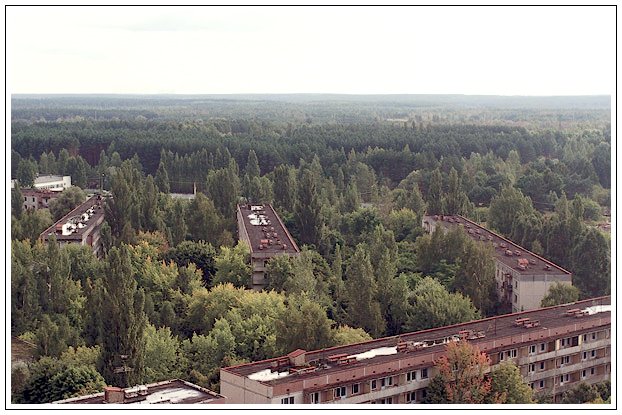 Fascinating and moving (if also rather eerie) page showing photographs of Chernobyl, 20 years after the nuclear disaster.
 Though a few people have returned to live in the city, most of the city is unchanged from when it was abandoned. Apart from its gradual, slow decay, some Banksy-style street-art, and the encroachment of the forest (see picture, right), the city is now something of a Soviet Union time-capsule - which seems entirely fitting.
HT: Jason.
Quite a punch-up on Craig's blog yesterday relating to a contributor who took great offence at the suggestion that (as s/he put it) "a bad person who attends church will be 'saved', but a good person who does not attend church will not be saved", arguing:
If we are to believe that no-one can be saved on their merits, why bother to be decent and good? Why do the "right thing"? Why not live a life of total disregard for others, and then every so often run off to church and repent? Is that truly what God wants us to do? I don't believe so.Well, I just came across the following quotation from the great Dr Martyn Lloyd-Jones (who has also cropped up on Craig's blog this week), in which the Doctor addresses this very point:
It is true that where sin abounded grace has much more abounded; well then, "Shall we continue in sin that grace may abound yet further?" The true preaching of the gospel of salvation by grace alone always leads to the possibility of this charge being brought against it.
There is no better test as to whether a man is really preaching the New Testament gospel than this, that some people might misunderstand it and mis-interpret it that it really amounts to this: that because you are saved by grace alone, it does not really matter at all what you do, you can go on sinning all you like because it will redound all the more to the glory of grace.
That is a very good test of gospel preaching. If my preaching of the gospel does not expose it to that misunderstanding, then it is not the gospel. Let me show you what I mean.
If a man preaches justification by works, no one would ever raise the question. If he says, "If you want to go to heaven, you must stop committing sins, live a life filled with good works, and keep this up regularly and constantly until the end, then you will be a Christian and go to heaven when you die." Obviously, no one will accuse a man who preached like this of saying, "Let us continue in sin that grace may abound."
But every preacher who preached the gospel has been accused of this! They have all been accused of "antinomianism." I would say to all preachers: if your preaching of salvation has not been misunderstood in that way, then you had better examine your sermons again, and you had better make sure that you really are preaching the salvation that is proclaimed in the New Testament to the ungodly, the sinner, to those who are dead in trespasses and sins, to those who are the enemies of God. There is a kind of dangerous element about the true presentation of the doctrine of salvation.
Tuesday, September 12, 2006 AD
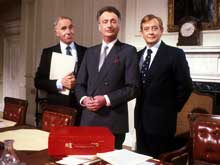 Returning to the topic of dubious opinion polls, the 9/11 poll may also demonstrate the phenomenon of "commitment consistency", a concept demonstrated many years ago in a classic scene from the 1980s political sitcom, "Yes, Prime Minister".
In one episode, the prime minister, Jim Hacker (pictured, centre), has been persuaded to consider reintroducing National Service (i.e. conscription). The cabinet secretary, Sir Humphrey Appleby (left), is appalled by this suggestion, and discusses with his underling Bernard Woolley (the PM's principal private secretary, right) how to undermine one of the arguments that has influenced the PM, namely an opinion poll apparently proving that "the Man In The Street" supports the return of National Service.
As Sir Humphrey explains:
The secret is that when the Man In The Street is approached by a nice attractive young lady with a clipboard he is asked a series of questions. Naturally the Man In The Street wants to make a good impression and doesn't want to make a fool of himself. So the market researcher asks questions designed to elicit consistent answers.The opinion poll then only reports the final question and answer.
Sir Humphrey goes on to ask Bernard the series of questions used in the poll whose results the PM had found so persuasive:
H: Mr Woolley, are you worried about the rise in crime among teenagers?Sir Humphrey then suggests commissioning a new survey designed to elicit the opposite outcome:
B: Yes!
H: Do you think there is a lack of discipline and vigorous training in our Comprehensive Schools?
B: Yes!
H: Do you think young people welcome some structure and leadership in their lives?
B: Yes!
H: Do they respond to a challenge?
B: Yes!
H: Might you be in favour of reintroducing National Service?
B: Yes!
H: Mr Woolley, are you worried about the danger of war?As Sir Humphrey says, crowing with delight: "You see, Bernard, you're the perfect Balanced Sample."
B: Yes!
H: Are you unhappy about the growth of armaments?
B: Yes!
H: Do you think there is a danger in giving young people guns and teaching them how to kill?
B: Yes!
H: Do you think it wrong to force people to take up arms against their will?
B: Yes!
H: Would you oppose the reintroduction of National Service?
B: Yes!
Monday, September 11, 2006 AD
In 2001, my wife and I were homegroup leaders in the Anglican church we were then attending, and I just came across a short Bible study I prepared for the meeting on Wednesday 12 September 2001. I hope this bears repeating today.
We looked at the following passages (supplementary/supporting passages in brackets):
We looked at the following passages (supplementary/supporting passages in brackets):
- Amos 3:3-6; (Acts 2:23)
- Luke 13:1-5; (Hosea 6:1; Lam. 3:37-42, NB 1:1)
- Romans 8:18-23
- Revelation 21:1-4
- God is in control, even when human beings do terrible things.
- The correct way to respond to such calamities is not to blame God or deny his control over the world,but to humble ourselves, repent and return to the Lord.
- Such events remind us we live in a fallen world, that life is fragile and fleeting, and that we need to look ahead to our future hope rather than being too attached to this world. But more positively, that reminds us what a glorious hope we do have as Christians.
- But disasters like this also remind us how serious our task is in evangelism: we are not just recommending the Christian life as a nice way to live, we are calling rebellious sinners in a fallen world to repent and return to the Lord before they perish. How many of those who died yesterday were ready to meet God? Are we?
Sunday, September 10, 2006 AD
I've been a bit behind the times, obviously, because until reading this story yesterday I didn't realise that - shock, horror! - 36% of Americans think the government was involved in the 9/11 attacks!!! Yes, you can fool some of the people all of the time, Mr President, but you can't fool all of the great American public for all of the time, and sooner or later, yada yada yada.
Well, I'm a suspicious soul, so rather than taking this at face value I thought I'd take a look at the actual poll results, paying particular attention to the context in which the money question was asked.
After lots of bending and stretching with standard poll questions ("In general do you approve or disapprove of the job George W, Bush is doing as president?"), followed by a sustained war of attrition on the respondents' sanity ("How would you have voted in each of the last eleven presidential elections, and yes we are going to make you sit through us telling you the slate on each one individually"), we then get to the section leading up to the "36%" question. Here are the questions:
First, the anger question. It's revealing that 77% of respondents think "people they know personally" are angrier with the federal government than they used to be (whatever that means), but only 54% are themselves angrier with the federal government than they used to be. OK, that's still a lot, but that's not the figure the pollsters splashed with, of course.
But anyway, the question's done its job: got people thinking about the federal government in terms of how "angry" they are towards it or not.
Then you get people thinking about the possibility of government involvement in high-profile national tragedies (JFK) and in cover-ups of crucial, but possibly alarming, information (life on Mars - ironically we've just been watching the West Wing episode of that title, which uses that allegation as the McGuffin). And only then - once you've reminded people about how angry they should be feeling towards the murderous and secretive federal government - do you hit them with the 9/11 questions.
And then let's look at the main question in more detail. This is reported as "36% of Americans think it likely the US government was complicit in the 9/11 attacks". Here's the actual question again:
Looking at the answers to the preceding and succeeding questions, it is entirely to the credit of the respondents in this survey that they were more sceptical of this statement - a statement giving every impression of having been constructed so as to maximise positive responses ("either ... or") - than they were of the federal government covering up The Truth About Alien Life (38%) or whacking the 35th President (40%).
And when you turn to the specific allegations of Cruise missiles being lobbed at the Pentagon or the Twin Towers being brought down by controlled explosions, those figures drop to 12% and 16% respectively. And the higher figure for the latter question could be explained, in part, by the fact that (unlike the Pentagon question, which specifically named the US military as the purported culprits) the question does not specify who is alleged to have planted the explosives, so some people may have speculated that the terrorists had planted these explosives.
But who knows? One thing's for sure - this poll isn't going to provide the answer to those questions.
This poll may or may not be an insult to the victims of 9/11. But it's certainly an insult to everyone else's intelligence.
Well, I'm a suspicious soul, so rather than taking this at face value I thought I'd take a look at the actual poll results, paying particular attention to the context in which the money question was asked.
After lots of bending and stretching with standard poll questions ("In general do you approve or disapprove of the job George W, Bush is doing as president?"), followed by a sustained war of attrition on the respondents' sanity ("How would you have voted in each of the last eleven presidential elections, and yes we are going to make you sit through us telling you the slate on each one individually"), we then get to the section leading up to the "36%" question. Here are the questions:
- Does it seem to you that the people you know personally are more angry with the federal government these days than they used to be?
- Are you, personally, more angry at the federal government than you used to be?
- Here are several serious accusations that some people have made against the federal government in recent years. Please tell me if you think each of these is very likely, somewhat likely, or unlikely. Officials in the federal government were directly responsible for the assassination of President Kennedy. Is this very likely, somewhat likely, or unlikely?
- The federal government is withholding proof of the existence of intelligent life from other planets.
- There are also accusations being made following the 9/11 terrorist attack. One of these is: People in the federal government either assisted in the 9/11 attacks or took no action to stop the attacks because they wanted to United States to go to war in the Middle East.
- The Pentagon was not struck by an airliner captured by terrorists but, instead was hit by a cruise missile fired by the U.S. military.
- The collapse of the twin towers in New York was aided by explosives secretly planted in the two buildings.
First, the anger question. It's revealing that 77% of respondents think "people they know personally" are angrier with the federal government than they used to be (whatever that means), but only 54% are themselves angrier with the federal government than they used to be. OK, that's still a lot, but that's not the figure the pollsters splashed with, of course.
But anyway, the question's done its job: got people thinking about the federal government in terms of how "angry" they are towards it or not.
Then you get people thinking about the possibility of government involvement in high-profile national tragedies (JFK) and in cover-ups of crucial, but possibly alarming, information (life on Mars - ironically we've just been watching the West Wing episode of that title, which uses that allegation as the McGuffin). And only then - once you've reminded people about how angry they should be feeling towards the murderous and secretive federal government - do you hit them with the 9/11 questions.
And then let's look at the main question in more detail. This is reported as "36% of Americans think it likely the US government was complicit in the 9/11 attacks". Here's the actual question again:
People in the federal government either assisted in the 9/11 attacks or took no action to stop the attacks because they wanted to United States to go to war in the Middle East."People in the federal government"? Which people? "Either assisted ... or took no action"? Well, "either/or" questions like this are a classic polling ploy - you give two options, then report people's responses only in terms of the first. I mean, even I might not entirely rule out the possibility that someone, somewhere in the federal government (total federal payroll in 2001: 2,697,602) had some inkling something big might be going down, but thought, "Well, there ain't much we can do to stop it, and I suppose it might at least jolt us into doing something about the Middle East". But then (if I were American) that would put me in the 36% of my countrymen who, apparently, consider it "likely" the government was "complicit" in the attacks.
Looking at the answers to the preceding and succeeding questions, it is entirely to the credit of the respondents in this survey that they were more sceptical of this statement - a statement giving every impression of having been constructed so as to maximise positive responses ("either ... or") - than they were of the federal government covering up The Truth About Alien Life (38%) or whacking the 35th President (40%).
And when you turn to the specific allegations of Cruise missiles being lobbed at the Pentagon or the Twin Towers being brought down by controlled explosions, those figures drop to 12% and 16% respectively. And the higher figure for the latter question could be explained, in part, by the fact that (unlike the Pentagon question, which specifically named the US military as the purported culprits) the question does not specify who is alleged to have planted the explosives, so some people may have speculated that the terrorists had planted these explosives.
But who knows? One thing's for sure - this poll isn't going to provide the answer to those questions.
This poll may or may not be an insult to the victims of 9/11. But it's certainly an insult to everyone else's intelligence.
It doesn't get easier; you just get faster. - Greg Lemond.Remind me again what it is that pride goeth before? Here is a post I prepared late last night, but held off from posting on the grounds it came across as a tad boastful and conceited (but hey, I got it out of my system):
New toyWell, "next time" happened this afternoon. Normally I only go out once on a weekend, but it's a gorgeous day, and - bearing in mind that it's not that long till I'll have to go back to my old bike for the winter - I decided to make the most of my new acquisition by going for another ride.
"Man built this... It's a vehicle."
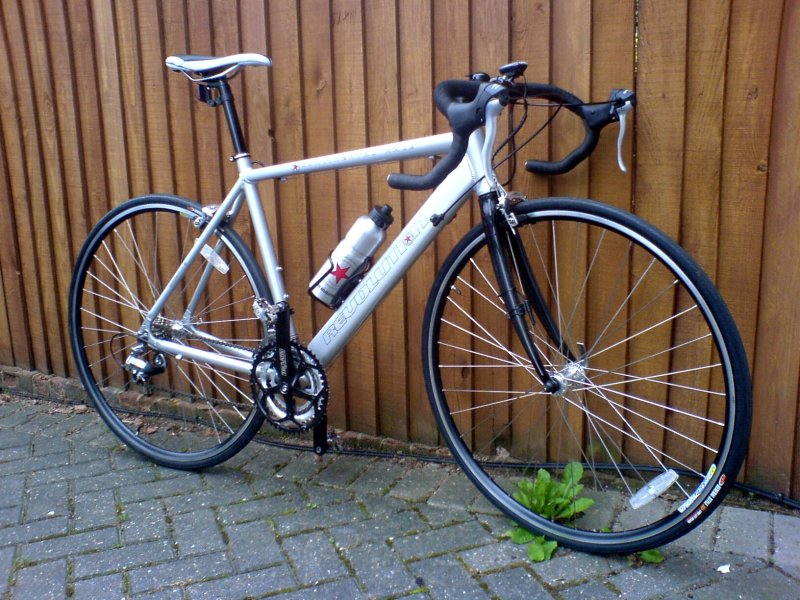
Went out for my first proper ride today on my new toy, a Revolution Continental Race from the Edinburgh Bicycle Cooperative (motto: "The Revolution Will Not Be Motorised".
OK, so it's a little more "entry-level" than, say, this baby, but I still managed my fastest speed ever going down Brasted Hill on the North Downs: 79 km/h, agonisingly falling short of 50 mph. Oh well, there's always next time. :-)
Oh. Dear.
With twenty miles yesterday and a swim this lunchtime in my not-especially-fit legs, I was soon in trouble. I got off to a humiliating start soon after leaving home, as I attempted to get onto the back wheel of another cyclist - a guy old enough to be my father, and just as quick on his bike as my (lifelong cyclist) father. (Riding close to the back wheel of another cyclist reduces wind resistance.)
Hanging onto someone else's wheel without reciprocating is a royal road to cycling unpopularity, so after a few hundred metres I felt I ought to take a turn at the front. By this time the road was beginning to climb a little, but in my pride I was reluctant to drop down on to my "granny ring" (the third chain ring at the front, intended for easier climbing but disdained by more "serious" cyclists - and noticeably absent from my more - ahem - experienced companion's own machine).
Well, that didn't last too long. After an embarrassingly short period of time, I dropped back, let grandad go past, and watched him disappear into the distance. I then proceeded to stagger round an abbreviated 12-mile loop, making a mental note to have a few days' rest before venturing out again.
But hey, I still think that was a great Simpsons quote to kick off that other post...
Saturday, September 09, 2006 AD
Some interesting thoughts from Conrad Gempf contrasting liturgical and non-liturgical modes of worship (Gempf uses the terms "low church" and "high church", of which more below).
First, on calls to make church services more "relevant" by ditching liturgy, vestments etc:
But the image of people wandering around in robes and chanting responsively in every life until the 1980s is an entertaining one. And now it simply doesn't happen. Something else we can blame Mrs Thatcher for, no doubt.
First, on calls to make church services more "relevant" by ditching liturgy, vestments etc:
Sometimes postmoderns seem to think that 'old-fashioned' church was a relic of 1950s culture. As if our churches need to be updated because ordinary people on the street stopped going around in robes and chanting responsively on buses sometime in the 1980s. Part of the point was that it was not our culture, that it was counter-cultural.Vestments in particular are not a holdover from an earlier, now superseded, cultural paradigm, but reflect an approach towards worship that has continuing relevance - perhaps all the more so in a personality-obsessed culture:
Priests dressed in robes rather than dressing as themselves to deflect attention from themselves; from personalities. The priests are not up there because of who they are, but because of the role they were given to play in representing/summarising the congregation before God and representing God to the congregation (depending on which way they're facing at the front, as it happens).And then there's the nature of worship itself, and particularly how the singing of hymns fits into that:
In a low church setting ... your 'time of worship' is the singing. In a high church setting, you interrupt the serious business of worship to take time out to express how you feel about it through singing.What I don't entirely agree with is Gempf's use of the terms "low church" and "high church". Historically, "low church" worship was liturgical (sung Matins from the 1662 BCP, for example, or the Lutheran Hymnal's "Divine Service Without Holy Communion"). And some "low church" evangelicals are equally critical of the recent tendency to equate "worship" with singing: see this post from a couple of years ago on a critique of the "praise and worship" movement from a Sydney Anglican perspective.
But the image of people wandering around in robes and chanting responsively in every life until the 1980s is an entertaining one. And now it simply doesn't happen. Something else we can blame Mrs Thatcher for, no doubt.
Thursday, September 07, 2006 AD


Wednesday, September 06, 2006 AD
Thinking further about the Heidelberg Catechism (see previous post), it strikes me that much of the difference between Lutheran and Reformed teachings is summed up in the contrasting answers given to two questions by the Heidelberg Catechism and the Lutheran confessions, particularly the Augsburg Confession and Luther's Small Catechism (both of which were clearly in mind when the Heidelberg Catechism was drawn up).
1. Where does faith come from?
First of all, here's question 65 from Heidelberg:
But in Heidelberg Q.65, the Word and the sacraments are separated from one another and have distinctive functions: the preaching of the gospel (and not the sacraments, least of all Baptism) is the means by which God first works faith in us, and only once faith is there can it then be "strengthened" by means of the sacraments. While the framers of the Heidelberg Catechism may not have intended to push the sacraments into a secondary role by making this distinction, that was the eventual outcome in much of Reformed Christianity.
2. What's going on in Baptism?
Here's Heidelberg Q.69, the first question on Baptism. Again, the (quite deliberate and intentional) parallels with the Lutheran confessions can be seen clearly:
To put it another way, for Heidelberg, the promises accompany Baptism but are distinct from it ("Christ instituted this outward washing and with it gave the promise"). It lacks the concept of the water and the word being "combined", as found in Luther's first question on Baptism.
Luther's third question on Baptism is, not unreasonably, "How can water do such great things?", for which his answer is:
The Lutherans of the Palatinate clearly knew their Small Catechisms, because the Heidelberg Catechism immediately has to go on to rebut the closing words of Luther's third question on Baptism, which I previously omitted:
1. Where does faith come from?
First of all, here's question 65 from Heidelberg:
Q. Since then faith alone makes us share in Christ and all His benefits, where does this faith come from?Spot what's going on there? Contrast this with the parallel statement in the Lutheran confessions, Article V of the Augsburg Confession:
A. From the Holy Spirit, who works it in our hearts by the preaching of the gospel, and strengthens it by the use of the sacraments.
So that we may obtain this faith, the ministry of teaching the gospel and administering the sacraments was instituted. For through the Word and the sacraments as through instruments the Holy Spirit is given, who effects faith where and when it pleases God in those who hear the gospel, that is to say, in those who hear that God, not on account of our own merits but on account of Christ, justifies those who believe that they are received into grace on account of Christ.You see the difference? In Article V of Augsburg, the Word (specifically, the preaching of the gospel) and the sacraments are both equally instruments through which the Holy Spirit is given, who effects faith in those who hear. As Dr Hermann Sasse points out, what is really in view here is merely different means by which the same Word of God comes to us: in preaching, in Baptism, in the Lord's Supper, in Absolution.
But in Heidelberg Q.65, the Word and the sacraments are separated from one another and have distinctive functions: the preaching of the gospel (and not the sacraments, least of all Baptism) is the means by which God first works faith in us, and only once faith is there can it then be "strengthened" by means of the sacraments. While the framers of the Heidelberg Catechism may not have intended to push the sacraments into a secondary role by making this distinction, that was the eventual outcome in much of Reformed Christianity.
2. What's going on in Baptism?
Here's Heidelberg Q.69, the first question on Baptism. Again, the (quite deliberate and intentional) parallels with the Lutheran confessions can be seen clearly:
Q. How does holy baptism signify and seal to you that the one sacrifice of Christ on the cross benefits you?Contrast Luther's Small Catechism on Holy Baptism, second question:
A. In this way: Christ instituted this outward washing and with it gave the promise that, as surely as water washes away the dirt from the body, so certainly His blood and Spirit wash away the impurity of my soul, that is, all my sins.
What benefits does Baptism give?So in Heidelberg, Baptism signifies and seals something that happens separately (though in connection with) the physical act of Baptism, namely Christ's blood and Spirit washing away our sins; in Wittenberg, Baptism doesn't merely signify these things, it effects them.
It works forgiveness of sins, rescues from death and the devil, and gives eternal salvation to all who believe this, as the words and promises of God declare.
To put it another way, for Heidelberg, the promises accompany Baptism but are distinct from it ("Christ instituted this outward washing and with it gave the promise"). It lacks the concept of the water and the word being "combined", as found in Luther's first question on Baptism.
Luther's third question on Baptism is, not unreasonably, "How can water do such great things?", for which his answer is:
Certainly not just water, but the word of God in and with the water does these things, along with the faith which trusts this word of God in the water. For without God's word the water is plain water and no Baptism. But with the word of God it is a Baptism, that is, a life-giving water, rich in grace, and a washing of the new birth in the Holy Spirit...Heidelberg has a rather different answer to that question, with its own Q.72:
Q. Does this outward washing with water itself wash away sins?Again, the effects of Baptism are quite separate from the physical act of Baptism. It isn't "the word of God in and with the water" that does these things; it is the blood of Jesus Christ and the Holy Spirit - an early example of the separation of Word and Spirit that has caused great problems for many evangelicals over the years.
A. No, only the blood of Jesus Christ and the Holy Spirit cleanse us from all sins.
The Lutherans of the Palatinate clearly knew their Small Catechisms, because the Heidelberg Catechism immediately has to go on to rebut the closing words of Luther's third question on Baptism, which I previously omitted:
...as St. Paul says in Titus, chapter three: "He saved us through the washing of rebirth and renewal by the Holy Spirit, whom He poured out on us generously through Jesus Christ our Saviour, so that, having been justified by His grace, we might become heirs having the hope of eternal life. This is a trustworthy saying"How does Heidelberg answer this citation? Like this:
Q. Why then does the Holy Spirit call baptism the washing of regeneration and the washing away of sins?Yes, but again, that's not what God actually says in Titus 3, is it? Again, we see a bold Scriptural statement about the efficacy of Baptism reinterpreted as something weaker: for Heidelberg, Baptism is not called a washing of rebirth because it is a washing of rebirth, but because being reborn is a bit like being washed.
A. God speaks in this way for a good reason. He wants to teach us that the blood and Spirit of Christ remove our sins just as water takes away dirt from the body. But, even more important, He wants to assure us by this divine pledge and sign that we are as truly cleansed from our sins spiritually as we are bodily washed with water.
Monday, September 04, 2006 AD
In addition to the Anglo-Genevan Psalter (see yesterday's post), the Book of Praise also contains the confessions of the continental Reformed churches (the "three forms of unity"), and in particular the Heidelberg Catechism.
Back in my Reformed days, this was my favourite of the Reformed catechisms. It turned out that this was because it is the most Lutheran, not least because it was written for a Lutheran crowd: it was intended to unite Reformed and Lutheran believers in the Palatinate, or at least to express Reformed doctrine in a manner that would be as palatable as possible to Lutherans.
From a Lutheran perspective, a lot of the Catechism's answers are pretty unsatisfactory, especially its explicit rejection of baptismal regeneration and the Real Presence. Instead, it takes a "just as surely as X happens, so does Y" approach:
And apart from these specific disagreements over content, the form of the Heidelberg Catechism moves away from the pastoral focus of Luther's Small Catechism to a more didactic and polemical approach, an approach that was to reach its height in the Westminster Shorter and Large Catechisms a century later. (This is one reason why I found the Small Catechism so appealing even while I was still Reformed.)
But that aside, the Heidelberg Catechism still has some material in it to stir the heart of any Augsburg Evangelical. Here are some examples:
Back in my Reformed days, this was my favourite of the Reformed catechisms. It turned out that this was because it is the most Lutheran, not least because it was written for a Lutheran crowd: it was intended to unite Reformed and Lutheran believers in the Palatinate, or at least to express Reformed doctrine in a manner that would be as palatable as possible to Lutherans.
From a Lutheran perspective, a lot of the Catechism's answers are pretty unsatisfactory, especially its explicit rejection of baptismal regeneration and the Real Presence. Instead, it takes a "just as surely as X happens, so does Y" approach:
"...we are as truly cleansed from our sins spiritually as we are bodily washed with water..." (Q.73)All well and good, but our Lord didn't say, "Just as surely as you eat this bread, so you feed spiritually on my body". He said, "This is my body". However, from a personal view, the Heidelberg Catechism's approach to the sacraments was a staging post for me on the journey from a Reformed Anglican to a Lutheran understanding of Baptism and the Lord's Supper.
"...as I see with my eyes the bread of the Lord broken for me and the cup given to me, so surely was His body offered for me and His blood poured out for me on the cross... as surely as I receive from the hand of the minister and taste with my mouth the bread and the cup of the Lord as sure signs of Christ's body and blood, so surely does He Himself nourish and refresh my soul to everlasting life with His crucified body and shed blood." (Q.75)
And apart from these specific disagreements over content, the form of the Heidelberg Catechism moves away from the pastoral focus of Luther's Small Catechism to a more didactic and polemical approach, an approach that was to reach its height in the Westminster Shorter and Large Catechisms a century later. (This is one reason why I found the Small Catechism so appealing even while I was still Reformed.)
But that aside, the Heidelberg Catechism still has some material in it to stir the heart of any Augsburg Evangelical. Here are some examples:
34. Why do you call Him our Lord?But best of all is the first question and answer, which stands comparison with Luther's exposition of the Second Article in the Small Catechism (on which it is clearly based):
A. Because He has ransomed us, body and soul, from all our sins, not with silver or gold but with His precious blood, and has freed us from all the power of the devil to make us His own possession.
60. How are you righteous before God?
A. Only by true faith in Jesus Christ. Although my conscience accuses me that I have grievously sinned against all God's commandments, have never kept any of them, and am still inclined to all evil, yet God, without any merit of my own, out of mere grace, imputes to me the perfect satisfaction, righteousness, and holiness of Christ. He grants these to me as if I had never had nor committed any sin, and as if I myself had accomplished all the obedience which Christ has rendered for me, if only I accept this gift with a believing heart.
61. Why do you say that you are righteous only by faith?
A. Not that I am acceptable to God on account of the worthiness of my faith, for only the satisfaction, righteousness, and holiness of Christ is my righteousness before God. I can receive this righteousness and make it my own by faith only.
What is your only comfort in life and death?Altogether now... "This is most certainly true!"
That I am not my own,
but belong with body and soul,
both in life and in death,
to my faithful Saviour Jesus Christ.
He has fully paid for all my sins
with His precious blood,
and has set me free
from all the power of the devil.
He also preserves me in such a way
that without the will of my heavenly Father
not a hair can fall from my head;
indeed, all things must work together
for my salvation.
Therefore, by His Holy Spirit
He also assures me
of eternal life
and makes me heartily willing and ready
from now on to live for Him.
Sunday, September 03, 2006 AD
 I'm still waiting for the Lutheran Service Book to hit Amazon.com so I can buy it without having to pay CPH's transatlantic shipping charges (I think they charter a plane for each individual order...). In the meantime, I've been revisiting one of the hidden treasures of the Christian church: the 1998 Book of Praise of the Canadian and American Reformed Churches.
What makes this little volume special is that it is (as I understand) the only full edition of the Genevan Psalter currently available in English. The Genevan Psalter was published in 1562, to provide congregational music for Calvin's church in Geneva. Most of the tunes were written by Louis Bourgeois, and many were subsequently harmonised by Claude Goudimel.
The full edition of the Book of Praise is available as a free PDF download, with separate files for the psalms (1.1 MB) and the hymns (320 kB) (the hymns include a mixture of Genevan and other hymns). English readers can purchase a copy of the book from Norwich Reformed Church (a snip at £11 inc. P&P).
Musically, the Genevan Psalter is by far the most interesting and enjoyable of all metrical psalters. It is characterised by the dance-like syncopation that led Elizabeth I famously to dub its tunes "Genevan jigs". The effect is rather similar to the original version of "A Mighty Fortress" (MIDI) - a "Wittenberg jig", perhaps? - and can sound similarly strange to ears trained in the more four-square rhythms of English hymnody.
Some of the most famous tunes from the Genevan Psalter are as follows (numbers given are from the Book of Praise, with a preceding "H" indicating a hymn):
- Psalm 68, "the battle-hymn of the Huguenots", which I posted on recently (MIDI);
- Psalm 134, better known as "Old Hundredth" after it was adopted for that great English paraphrase of Psalm 100, "All People That On Earth Do Dwell" (Vaughan Williams' glorious arrangement can be heard as a Real Audio track here; contrast the Genevan-style MIDI version, particularly in the last line);
- Nunc Dimittis (H18): this gorgeous tune (exceptionally pleasant MIDI here) is best-known today as the tune for Robert Bridges' translation of Phos Hilaron, "O Gladsome Light"
- Psalm 98, with a tune (MIDI, a little too "jiggish" IMO) used in the communion hymn "Bread of the world in mercy broken".
- Psalm 1: for me, the first test of any psalter is "What's its Psalm 1 like?": a test that the NRSV fails miserably, but which the Genevan Psalter passes with flying colours, musically speaking (MIDI);
- Psalm 42 (also used for Isaiah 40 (H11)) (MIDI);
- Psalm 99: a real jig, this one (MIDI);
- Psalm 140, also used for the Ten Commandments (H7) (MIDI).
Interesting post by Marty Sweeney on Matthias Media's Couldn't Help Noticing blog, summarising an article by Presbyterian pastor Tim Keller on how to reach out to "Post-Everythings" in our society.
Revd Keller's main aim is to demonstrate that Reformed theology is capable of speaking to those who are post-Christian, postmodern, post-everything. Obviously he's wrong about that, and should have said "Lutheran" rather than "Reformed" ;-), but there are some points in there of real value even to those of us in the other stream of Reformational Christianity. Two examples cited by Revd Keller particularly struck me.
First, Geerhardus Vos, father of biblical theology (a Christ-centred approach to Scripture that has had a huge influence on me, particularly via Graeme Goldsworthy). "Post-everythings like narrative and story" is how Marty Sweeney summarises Revd Keller's message here, and Keller himself describes how Vos can help the church speak effectively to the post-everythings in our pews:
The second point came from that well-known Reformed theologian, Martin Luther, whom Keller cites as providing a means of responding to the hostility which he suggests post-everythings have towards "moralism and self-righteousness". As Keller writes:
Revd Keller's main aim is to demonstrate that Reformed theology is capable of speaking to those who are post-Christian, postmodern, post-everything. Obviously he's wrong about that, and should have said "Lutheran" rather than "Reformed" ;-), but there are some points in there of real value even to those of us in the other stream of Reformational Christianity. Two examples cited by Revd Keller particularly struck me.
First, Geerhardus Vos, father of biblical theology (a Christ-centred approach to Scripture that has had a huge influence on me, particularly via Graeme Goldsworthy). "Post-everythings like narrative and story" is how Marty Sweeney summarises Revd Keller's message here, and Keller himself describes how Vos can help the church speak effectively to the post-everythings in our pews:
If you know how to do Christ-centered preaching, then you turn every single sermon into a kind of story. The plot of the human dilemma thickens, and the hero that comes to the rescue is Jesus. Christ-centered preaching converts doctrinal lectures or little how-to talks into true sermons. Post-everythings who are interested in narrative are reached by such preaching that is deeply Reformed.But even more deeply Lutheran: what Keller(/Vos) is saying here sounds very much like Law/Gospel preaching - or, more to the point, a way to stop Law/Gospel preaching degenerating into a stereotypical "ten minutes of the hammer, ten minutes of Christ" approach that the likes of Josh S have been known to complain about.
The second point came from that well-known Reformed theologian, Martin Luther, whom Keller cites as providing a means of responding to the hostility which he suggests post-everythings have towards "moralism and self-righteousness". As Keller writes:
Traditional gospel presentations assume that the people want to be "good." But our kids' generation wants to be "free." Luther said, "Look, you want to be free? Good. It’s good to be free. But you’re not. You are living for something and, whatever that something is, it enslaves you."Even if we consider "post-everythings" to be no less moralistic and self-righteous than previous generations, only about different issues (racism, homophobia, environmental issues etc), Revd Keller is surely spot-on with this summary of how Luther's teachings on freedom can speak to us today.
If a person lives for reputation, then he is a slave to what people think. If a person lives for achievement, then he will be a workaholic. As did Luther, we should tell such people, "You want to be free? Fine. But you’re not going to be free unless Jesus is your salvation."
When post-everythings rejected Christianity they thought moralism and Christianity were the same thing. But we can show post-everythings that the two are not the same, and that freedom really is in Jesus.


